Taariika Sistemji Ruleet
Teemedannde ɗiɗi nde yimɓe ina mbinnda doosɗe ngam waylude pari maɓɓe.
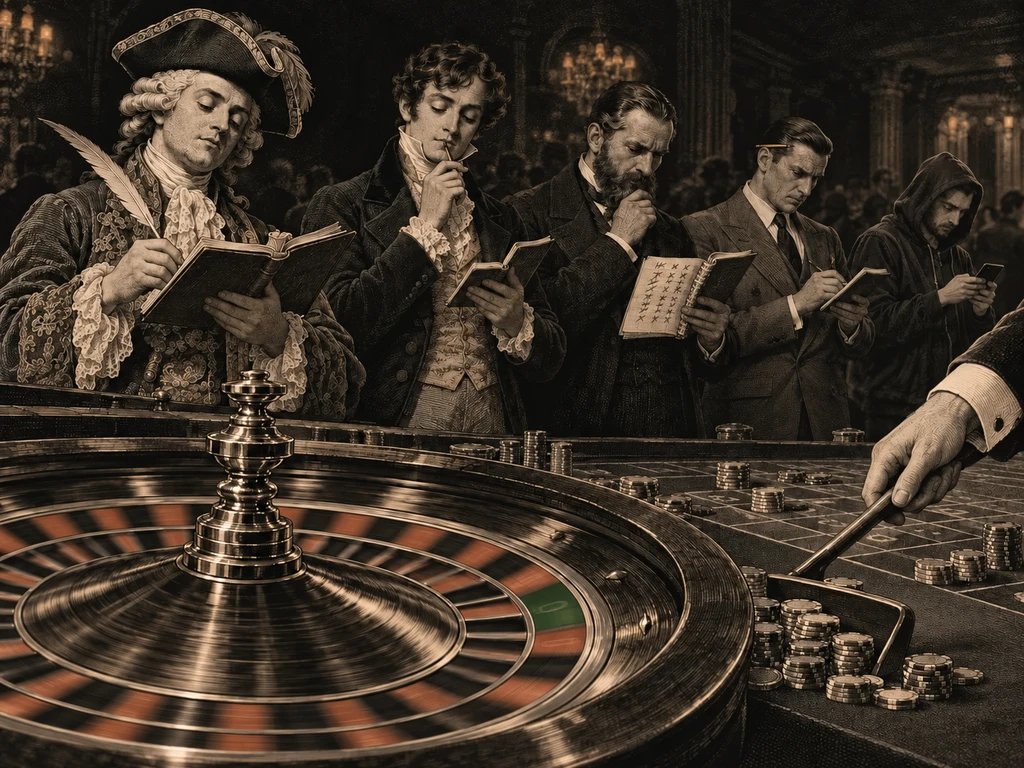
Martingale ko teemedannde 18ɓiire; D’Alembert ko ganndo kiisa mo yiɗaano ngal innirtee; Labouchère ko ko politikajo jamaanu Victoria welinoo. Hay gootol e majje golliraano ndeen kadi.
Martingale
The 1762 Académie française dictionary records martingaledabareMartingaleJokkondiral pari ɓeydoowo pari ɗiɗi laabi caggal kala majjere. Ƴeew hello Dabareeji ngam anndude ko ngal waɗata e ko ngal waɗataa.Tar fof → as a gambling term for staking what has been lost. Its 1878 edition explicitly describes doubling after a loss and also uses the word more broadly for betting schemes. These entries document usage; they do not identify a single inventor.
Today the familiar doubling progressiondabareJokkondiral pariKala sariya waylowo pari e njeñtuɗi ɓennuɗi. Jokkondiral caggal majjere ina ɓeyda pari caggal majjere, caggal dañal ina ɓeyda ɗum caggal dañal.Tar fof → aims to recover previous losses and gain one starting unitkaalisInitePari fuɗɗoode mo sistem walla fijoowo gollirta. Jokkondirɗe pari ina cifee e initeeji ngam ɗi kuutoroo e kala taabal.Tar fof → when a win arrives. A finite bankrollkaalisKaalis pariKaalis fof ko seŋaa ngam fijde. Toppitagol kaalis pari ko ñaawde ko foti waɗeede e kala pari e kala jonnde.Tar fof → or table limittaabalKeerol taabalPari ɓurɗo famɗude e ɓurɗo mawnude jaɓaaɗo. Keerol dow ngol ko ngol dartinta jokkondirɗe pari ɓeydooje ɗiɗi laabi.Tar fof → can stop the sequence first. The Strategy section shows how those limits affect a session.
D’Alembert
The progression bearing d’Alembert’s name raises the stake by one unit after a loss and lowers it after a win. The name alone does not prove who devised or endorsed the betting rule.
Its mathematical issue is straightforward: on independent spinsmatematikTaarle ceertuɗeKala taarol ina jogii porobabiliteeji gooti, no ko ɓenni wayiri fof. Ko ɗum woni ɓuuɓre kala hasbugol e lowre ndee.Tar fof →, a run of one outcome does not make the opposite outcome due. A famous namesake does not change that assumption or the payoutkaalisNjoɓdiKo pari dañndi ruttata, wiyaa “X e 1” ɓeydaa e pari ruttaaɗo.Tar fof →.
Labouchère
The cancellation system uses a list of numbers to determine the next stake. A win removes entries and a loss adds an entry; the Strategy section sets out the rules and examples. Historical stories about its namesake should be distinguished from evidence that the method creates an advantage.
A sequence may clear with a profit, but a losing run can leave a growing list and larger required stakes. How often it clears depends on the starting list, bankroll, limits and stopping rule. There is no universal success percentage.
Teemedannde 20ɓiire
A simulation can show how a specified system behaves under a chosen wheel model. It cannot test every possible rule, and a finite run need not return exactly the theoretical house edgematematikƁural kasinoGeɗal kala pari ngal kasino jogiiyata e hakkundeere: 2,70% e ruleet Orop.Tar fof →.
For independent uniform single-zerotaarordeSeeroSuudu haako wootere nde hay pari njoɓdi fotndi, sappo e ɗiɗi walla kolon kuuɓataa; ko ɗum woni iwdi ɓural kasino. Ina noddee kadi: seero gooto, 0.Tar fof → spins with standard full-loss-on-zero payouts, each unit staked has expected net return −1/37. For a bounded session whose stakes are chosen using information available before each spin, adding the conditional expectations gives expected lossmatematikMajjere fodaandeNjaru fodaandu fiyaandu e kaalis pariyaaɗo fof; ko hakkundeere kaalis majjataako nder jonnde walla nder sahaa.Tar fof → equal to 1/37 of expected turnoverkaalisKaalis pariyaaɗo fofKawrital kaalis pariyaaɗo nder jonnde walla sahaa, limtaa kadi kaalis dañaaɗo pariyaaɗo kadi. Ina noddee kadi: handle, action.Tar fof →. Stopping or changing stakes can change the distribution of results, but not create positive expectation under those assumptions. Other payouts, such as la partagesariyaLa partageSariya Farayse: so seero yalti, feccere pari njoɓdi fotndi ina ruttee. Ina feccita ɓural kasino e pariiji ɗii haa 1,35%.Tar fof →, need their own calculation.
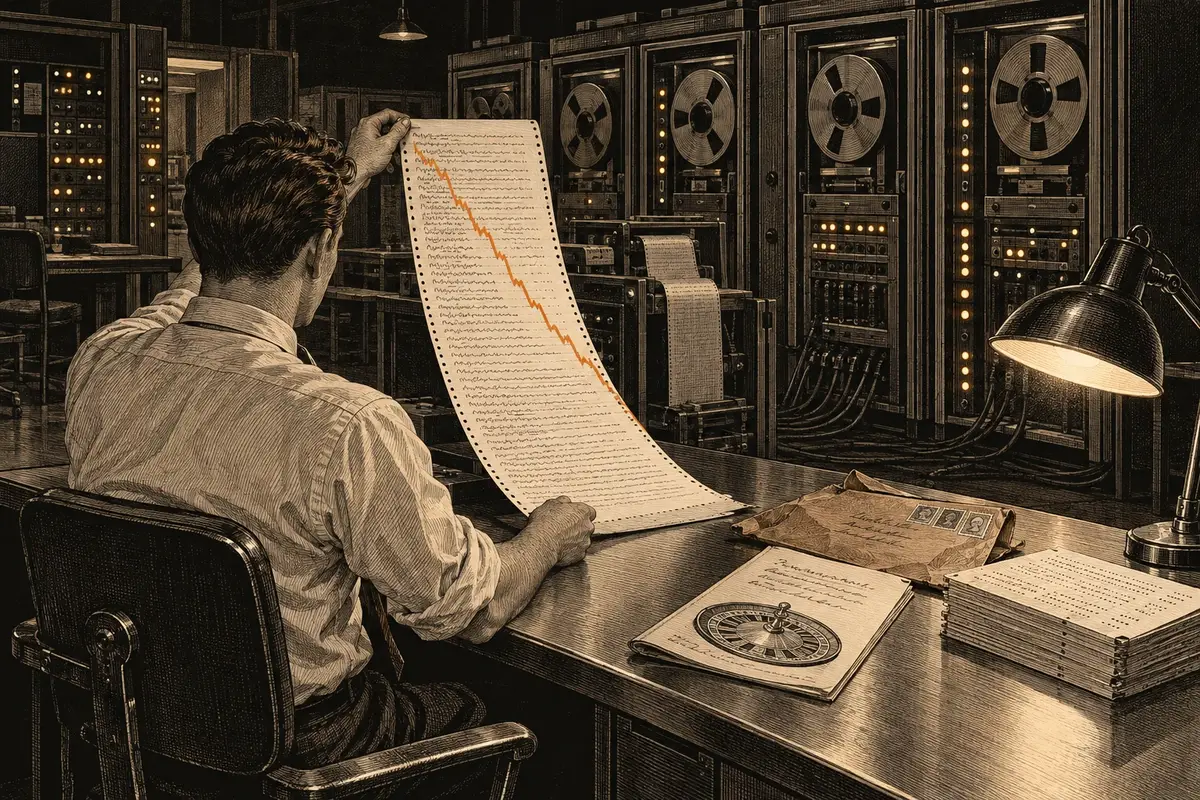
Miijo Juumɗo: Dabare Ruleet nde Dañata Sahaa KalaDabare Ruleet Fibonacci
Ko waɗi ɗi keddotoo
A demonstration can end in profit without showing that the method has an edge. Some rules favor frequent small wins at the cost of occasional large losses; others do the reverse. The proportions depend on the exact rules and limits.
When comparing systems, look at all completed sessions, total stakes, losses and stopping conditions. A selected winning example leaves out the information needed to assess the claim.
Sistemji njeeyaaɗi
Systems have also been sold with elaborate names and entry rules. The examples below illustrate the arithmetic of specific rules; they are not evidence of who first invented or marketed them. Waiting for a pattern does not alter the next independent spin’s probabilities.
Ngol wonaa sistem
Doosɗe darnde: suɓaade ko adii foti ko majjinaa walla ko dañaa, ndeen yaltaade. Ina keewi ɗe njeeyee wonde ko geɗal sistem, tee ko kañje tan ngoni geɗal waɗngal huunde, sabu ɗe ina ustoo kaalis pariyaaɗo fof. Ɗe alaa mo ɗe innirtee, ɗum ina haani.
Naamne
Martingale, ina ɓura ɗi kala e teemedannde walla ko ɓuri ɗuum. Ɗiɗmingol pari caggal majjere ko miijo adanngo kala neɗɗo.
D’Alembert ɓuri ɓadaade ɗum, e nder mo anndaa. Pascal, Fermat, Huygens, Bernoulli e Laplace fof ina ɓannginii ko waɗi ɗi waawaa.
Sabu ko ɓuri heewde e jonɗe ina daña, widewo jonnde dañal ina newi waɗde.
Ƴeewndo weltinoowo
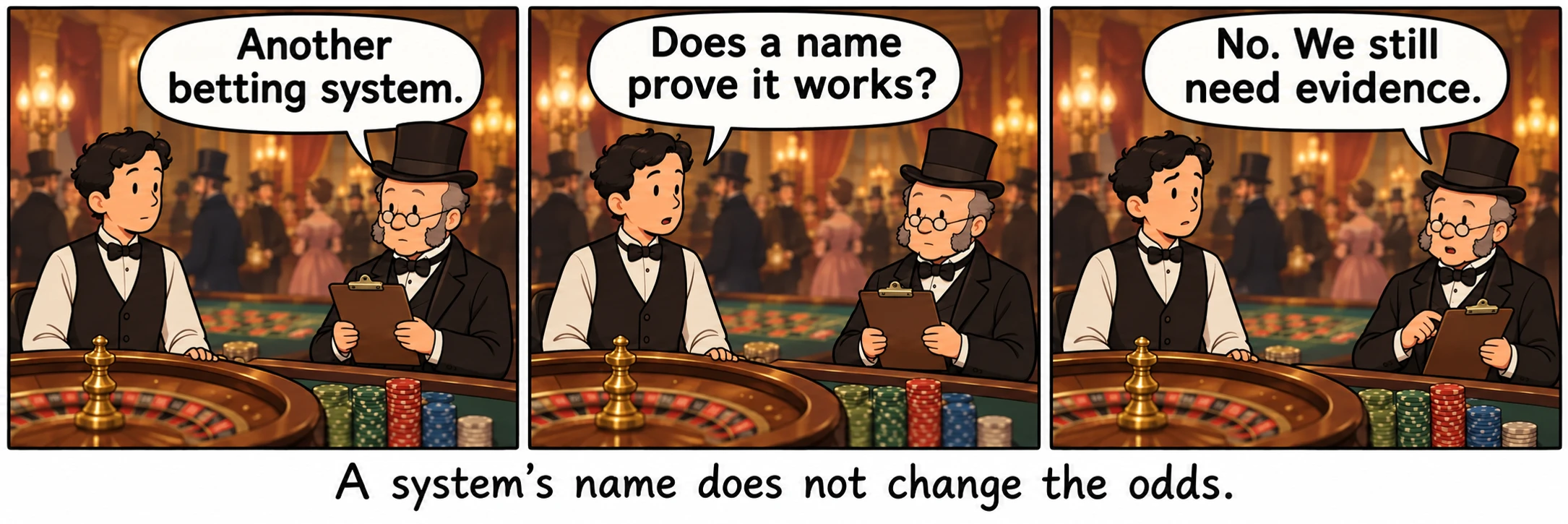
Teemedannde ɗiɗi inɗe. Limoore wootere.
Iwdi
- Thorp, E. O. “Optimal gambling systems for favorable games.”
- Thorp, E. O. The Mathematics of Gambling.
- Doob, J. L. “Note on probability.”
- Halmos, P. R. “Invariants of certain stochastic transformations: the mathematical theory of gambling systems.”
- d’Alembert, J. “Croix ou pile.”
- Schwartz, D. G. Roll the Bones: The History of Gambling.
- Kavanagh, T. M. Dice, Cards, Wheels: A Different History of French Culture.
- Bollman, M. Mathematics of the Big Four Casino Table Games: Blackjack, Baccarat, Craps, & Roulette.
- Académie française, martingale, 1762
- Académie française, martingale, 1878