Kelly Criterion e Ruleet
Kelly criterion ina sikkina fijoowo jogiiɗo ɓural ko o foti waɗde pari. E ruleet jaabawol mum ina laaɓi: hay huunde.
Pari Kelly = ɓural / kot. So ɓural ngal ko ɓuri les seero, formil ngol ina rutta feccere ɓurnde les seero, ɗum firti hoto waɗ pari. Kelly criterion ina nafa tawon ngam faamde ko waɗi fijooɓe taarorɗe ooñiiɗe ndenndii pariiji mum hono no ɓe ndenndiri, e ko waɗi woɗɓe ɓee fof ina poti ndenndude pari e bujee.
Kelly criterion
John Kelly (1956) asked how a gambler with a known edge should size bets to maximize long-run growth of the bankrollkaalisKaalis pariKaalis fof ko seŋaa ngam fijde. Toppitagol kaalis pari ko ñaawde ko foti waɗeede e kala pari e kala jonnde.Tar fof →. The answer, for a bet paying b to 1 with win probabilitymatematikPorobabiliteSahaa njeñtudi, immorde 0 haa 1 walla 0% haa 100%. Limoore wootere: 1/37 = 2,70%.Tar fof → p and loss probability q = 1 − p, is to stake the fraction f* = (bp − q) / b of the bankroll. Positive f* means bet that fraction; zero or negative means do not bet. Kelly worked at Bell Labs, and his paper, “A new interpretation of information rate”, set the problem in Claude Shannon’s theory of information: a gambler who gets tips over a noisy line, at fair odds, can grow the bankroll at best at the rate the line carries information. This is a growth objective under a probability model, not a promise to finish ahead after a particular number of bets. A spending limit, finite deadline or payoutkaalisNjoɓdiKo pari dañndi ruttata, wiyaa “X e 1” ɓeydaa e pari ruttaaɗo.Tar fof → cap changes the decision problem.
Pari Kelly e ruleet
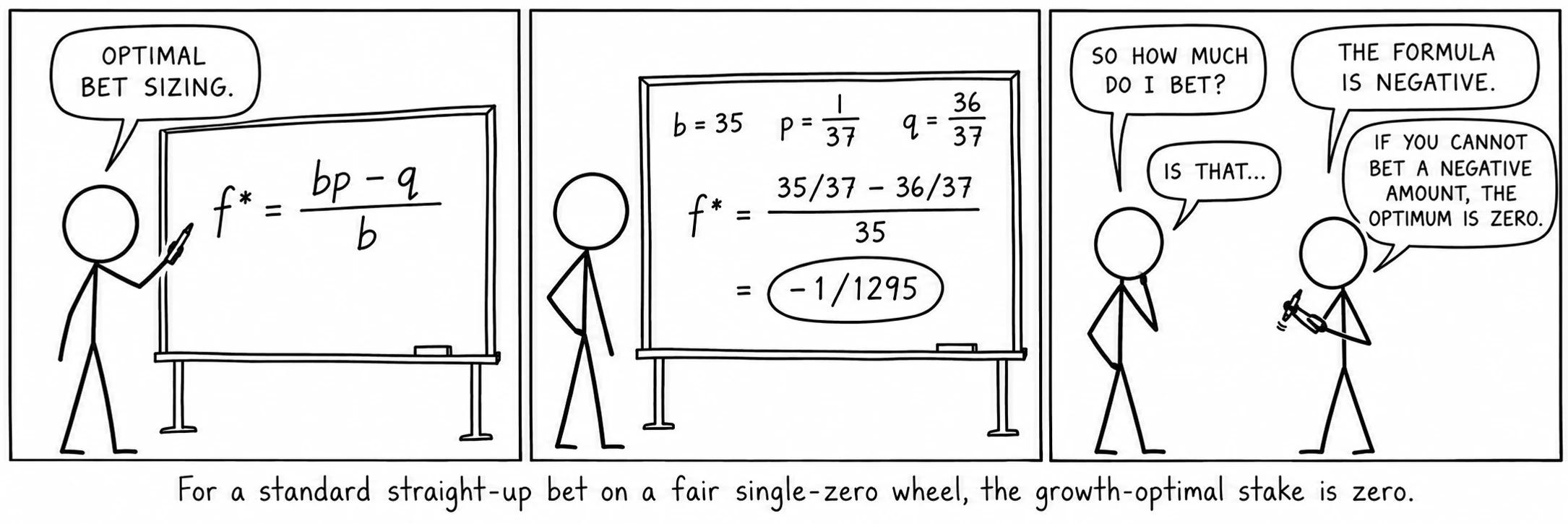
For redpariBoɗeerePari njoɓdi fotndi e limooje 18 boɗeeje. E Farayse: rouge.Tar fof →: b = 1, p = 18/37, q = 19/37; f* = (18/37 − 19/37)/1 = −1/37. For a straight uppariLimoore wootereLimoore wootere tan, ina yoɓa 35:1.Tar fof →: b = 35, p = 1/37, q = 36/37; f* = (35/37 − 36/37)/35 = −1/1295. Every standard bet gives a negative Kelly fraction, because every bet has a negative edge, and the growth-optimal stake is zero. Kelly betting on roulette is a formal way of saying what the house-edge page says: no positive stake maximizes expected logarithmic growth when the bet has negative expectation. A particular session can still end in profit. La partagesariyaLa partageSariya Farayse: so seero yalti, feccere pari njoɓdi fotndi ina ruttee. Ina feccita ɓural kasino e pariiji ɗii haa 1,35%.Tar fof → needs a separate three-outcome calculation: a win, a full loss or a half-loss on zerotaarordeSeeroSuudu haako wootere nde hay pari njoɓdi fotndi, sappo e ɗiɗi walla kolon kuuɓataa; ko ɗum woni iwdi ɓural kasino. Ina noddee kadi: seero gooto, 0.Tar fof →. Its expected log growth also falls as the stake increases from zero.
To Kelly nafi
Suppose a pocketkuutorɗeSuuduGootel e cuuɗi 37 limoraaɗi e rotoor. Ina noddee kadi: wenndu, kopp.Tar fof → really has a stable, known probability of 1 in 30 and pays 35 to 1. The Kelly fraction is 0.57%: about $57 from a $10,000 bankroll. Under independent spinsmatematikTaarle ceertuɗeKala taarol ina jogii porobabiliteeji gooti, no ko ɓenni wayiri fof. Ko ɗum woni ɓuuɓre kala hasbugol e lowre ndee.Tar fof → and exact fractional staking, the geometric growth factor over 1,000 spins is about 1.7. Expected bankroll grows faster because rare large wins pull up the average. These are model calculations, not evidence that any named historical player used Kelly or achieved this result.
Ko heewi wonde e hakkundeere
The gap between the typical bankroll and the average one is wide. Take a pocket that hits 1 time in 25, a hypothetical edge of 44% per unitkaalisInitePari fuɗɗoode mo sistem walla fijoowo gollirta. Jokkondirɗe pari ina cifee e initeeji ngam ɗi kuutoroo e kala taabal.Tar fof → staked. Kelly stakes 1.26% of the bankroll on it. After 1,000 spins the typical bankroll has grown about 11.5 times, while the average, pulled up by a few very lucky runs, has grown about 249 times. Betting more than Kelly raises the average and lowers the typical result: at twice the Kelly stake the typical bankroll only doubles, and by two and a half times the Kelly stake it shrinks, although every bet still carries a 44% edge. In this example, half-Kelly retains about 78% of the expected log growth. This fraction depends on the probabilities and payout.
So ɓural ngal ko sikke
Kelly uses the true probabilities, but a player usually has only estimates. Selecting the busiest pocket from a past record creates a selection problem: even a fair wheel has a busiest pocket. Its observed rate can overstate its future probability. Choosing the stake from that same record compounds the error. An independent follow-up sample helps test a proposed bias (see How to Detect Roulette Wheel Bias). Reducing the calculated fraction reduces exposure, but cannot turn a false edge into a real one.
Yimɓe jogiiɓe ɓural
Haghani and Dewey (2016) studied 61 participants given $25 and 30 minutes to bet on a simulated coin with a disclosed 60% chance of heads. The payout cap was $250; its value was revealed when a proposed winning bet would reach it. Their reported 21% success category included balances of at least $200, while the 28% “bust” category meant less than $2, not necessarily zero. Eighteen participants bet their entire balance on one flip. The uncapped Kelly fraction is 20%, but the cap and deadline change the optimization problem. The experiment illustrates how stake choices matter even with a known advantage; it does not establish one best strategy for every objective.
Ko huutoree nden
So alaa ɓural, ndenndugol pari ko naamnal bujee, wonaa naamnal ɓeydagol: pari = ko jaɓɗaa ndonkude e taarol kala, ɓaŋngol e bujee waktu e yaawngal taabal ngal (hello toppitagol kaalis pari). Ko Kelly rokki fijoowo jaɓɗo ko laaɓal jaabawol mum: seero. Kala ko waɗɗaa pari ɓurɗo seero ko coggu fijo, ko aan suɓi ɗum, wonaa formil feewnitiiɗo ɗum.
Konngol e feccere Kelly e “toppitagol kaalis”
Betting a fixed percentage of the current bankroll is proportional staking: the stake rises after wins and falls after losses. Flat bettingdabarePari fotɗiWaɗde pari gooto kala taarol. Ko ɗum kala jokkondiral pari kawrondirtee.Tar fof → instead keeps the cash stake fixed. Neither creates an edge on ordinary roulette. With infinitely divisible stakes and a fraction below 100%, proportional staking never reaches exactly zero in finitely many losses, but the balance can become arbitrarily small. Real table minimums can prevent further play much sooner. The growth-optimal fraction remains zero.
Formil
Naamne
Only when the actual probabilities, payouts and conditions give a credible positive advantage. Standard bets on an unbiased wheel have no such advantage.
Using half the calculated fraction reduces exposure to errors in the estimated edge. The familiar three-quarters-growth rule is an approximation for small advantages, not a universal identity. It does not protect against an edge that does not exist.
Alaa. Kelly ina feewnita ɓeydagol so ɓural ina woodi. Toppitagol kaalis pari ina toppita ndonkugol so ɓural alaa.
Weltaare e Matematik
Etu ɗum hoore maa adii. Kala jaabawol ina suuɗii; uddit ɗum so a heblii.
Suppose a hypothetical bet on one number has a known 44% edge under standard payoutskaalisNjoɓdiKo pari dañndi ruttata, wiyaa “X e 1” ɓeydaa e pari ruttaaɗo.Tar fof → and independent spinsmatematikTaarle ceertuɗeKala taarol ina jogii porobabiliteeji gooti, no ko ɓenni wayiri fof. Ko ɗum woni ɓuuɓre kala hasbugol e lowre ndee.Tar fof →. Kelly gives a 1.26% bankrollkaalisKaalis pariKaalis fof ko seŋaa ngam fijde. Toppitagol kaalis pari ko ñaawde ko foti waɗeede e kala pari e kala jonnde.Tar fof → fraction. What if the same 44% edge came on one bet spread over five neighboring numbers?
Hollu jaabawol ngol
Jaabawol Ndeen Kelly ina wiya 7,1% kaalis pari, kaalis pari ina ɓeydoo yaawde hono laabi jeegom: hono 1,25 miliyoŋ laabi e nder pariiji 1 000, e yeeso hono 11,5 laabi.
A straight uppariLimoore wootereLimoore wootere tan, ina yoɓa 35:1.Tar fof → with a 44% edge wins with chance 0.04, since 36 × 0.04 = 1.44. Kelly’s stake is the edge divided by the odds: 0.44/35 = 1.26%. The typical growth per bet is 0.04 × ln(1 + 35 × 0.0126) + 0.96 × ln(1 − 0.0126) ≈ 0.00244, so 1,000 bets multiply the bankroll by about e^2.44 ≈ 11.5.
Spread one stake over five numbers and the bet wins with chance 0.20 and pays 36/5 for 1, that is 6.2 to 1: still a 44% edge, since 0.2 × 7.2 = 1.44. Kelly’s stake becomes 0.44/6.2 = 7.10%, and the growth per bet 0.01404, about 5.75 times as much. Over 1,000 bets that is e^14.04, about 1.25 million.
The edge is the same; the swings are smaller. A bet that wins one time in five has a larger growth-optimal fraction in this model, although losses can still reduce the bankroll severely. This comparison assumes the same known edge for both bets; actual predictions need independent evidence.
Assume two numbers are adjacent on the betting layoutkuutorɗeTapiKaare pariiji winndaande e taabal. Ina noddee kadi: taabal, feetere, sanyo.Tar fof → and each has a stable, known probabilitymatematikPorobabiliteSahaa njeñtudi, immorde 0 haa 1 walla 0% haa 100%. Limoore wootere: 1/37 = 2,70%.Tar fof → of 1 in 25 on independent spins. Compare a splitpariLimooje ɗiɗiLimooje ɗiɗi takkondirɗe, ina yoɓa 17:1.Tar fof → between them at 17 to 1 with equal straight-up stakes on the two numbers. How much does Kelly say, and how fast does the bankroll grow compared with one such pocketkuutorɗeSuuduGootel e cuuɗi 37 limoraaɗi e rotoor. Ina noddee kadi: wenndu, kopp.Tar fof →?
Hollu jaabawol ngol
Jaabawol Ceerondiral alaa: 2,59% kaalis pari e limooje ɗiɗi, walla 1,29% e kala limoore. Kaalis pari aadanteeɗo ina ɓeydoo hono laabi 155 e taarle 1 000, e yeeso laabi 11,5 e suudu wootere.
The split wins with probability 2/25 = 0.08 and pays 17 to 1, so it returns 18 × 0.08 = 1.44 per unitkaalisInitePari fuɗɗoode mo sistem walla fijoowo gollirta. Jokkondirɗe pari ina cifee e initeeji ngam ɗi kuutoroo e kala taabal.Tar fof → staked: an edge of 44%, the same as one biased pocket. Kelly’s stake is the edge divided by the odds: 0.44/17 = 2.59%.
Two straight-up bets of 1.29% each give exactly the same results. When either number comes up, one chipkaalisJetoŋMaande hollirde kaalis tabitiiɗo, waɗetee e tapi ngam waɗde pari. Ina wiyee kadi: check.Tar fof → wins 35 to 1 and the other is lost, a net of 34 × 1.29% = 44% of the bankroll, as the split pays; when neither does, both are lost.
The growth per spin is 0.00505, against 0.00244 for one pocket, so over 1,000 spins the typical bankroll grows e^5.046 ≈ 155 times rather than e^2.44 ≈ 11.5 times. The geometric growth factor is larger because the combined bet wins more often at the same 44% edge. It is a model result, not a guaranteed bankroll.
Ƴeewndo weltinoowo
Pari ruleet ɓurndi moƴƴude ngam ɓeydagol ko limoore nde kala gooto anndi kisa.
Iwdi
- Kelly, J. L. “A new interpretation of information rate.”
- Breiman, L. “Optimal gambling systems for favorable games.”
- Thorp, E. O. “Optimal gambling systems for favorable games.”
- Thorp, E. O. The Mathematics of Gambling.
- Epstein, R. A. The Theory of Gambling and Statistical Logic, 2nd ed.
- Taylor, D. G. Games, Gambling, and Probability: An Introduction to Mathematics, 2nd ed.
- Ethier, S. N. The Doctrine of Chances: Probabilistic Aspects of Gambling.
- Haghani, V. & Dewey, R. “Rational decision-making under uncertainty: observed betting patterns on a biased coin.”