Porobabilite Jokkondire e Ruleet
Jokkondire juutɗe noone wootere ina heewi. Ɗe njogaaki kadi hay maanaa e taarol garoowol.
Boɗeeje joy jokkondirɗe: 2,7%. Sappo: 0,074%. E jonnde taarle 200, jokkondiral noone wootere jeegom ina ɓura heewde wonde e ko ɗum alaa.
No majjereeji jokkondirɗi ngarirta sahaa kala
Pari njoɓdi fotndi e taarorde seero gooto ina majja taarle 19 e 37. Kala gongol ko porobabilite kala taarle jokkondirɗe limtaaɗe majja, e ko fijoowo Martingale, ɓeydoowo pari laabi ɗiɗi caggal kala majjere, majjini haa ndeen.
| majjereeji jokkondirɗi | sahaa | hedde 1 e | majjinaaɗo haa jooni | pari garoowo |
|---|---|---|---|---|
| 1 | 51,4% | 2 | $1 | $2 |
| 2 | 26,4% | 4 | $3 | $4 |
| 3 | 13,5% | 7 | $7 | $8 |
| 4 | 7,0% | 14 | $15 | $16 |
| 5 | 3,6% | 28 | $31 | $32 |
| 6 | 1,8% | 55 | $63 | $64 |
| 7 | 0,94% | 106 | $127 | $128 |
| 8 | 0,48% | 207 | $255 | $256 |
| 9 | 0,25% | 403 | $511 | $512 |
| 10 | 0,13% | 784 | $1 023 | $1 024 |
| 11 | 0,065% | 1527 | $2 047 | $2 048 |
| 12 | 0,034% | 2974 | $4 095 | $4 096 |
| 13 | 0,017% | 5792 | $8 191 | $8 192 |
| 14 | 0,0089% | 11279 | $16 383 | $16 384 |
| 15 | 0,0046% | 21965 | $32 767 | $32 768 |
Porobabilite ndee ko 19/37 fiilaaɗo e hoore mum laabi foti e majjereeji, limtaaɗi gila e taarol gootol anndaangol. Jonnde juutnde ina jogii taarle keewɗe ɗe jokkondiral ngal waawi fuɗɗaade, ɗum noon e nder kikiiɗe gootol ina ɓuri wonde no feewi ko gongol gootol hollata.
Jokkondiral gootal
PorobabilitematematikPorobabiliteSahaa njeñtudi, immorde 0 haa 1 walla 0% haa 100%. Limoore wootere: 1/37 = 2,70%.Tar fof → wonde taarle k garooje fof ko boɗeejepariBoɗeerePari njoɓdi fotndi e limooje 18 boɗeeje. E Farayse: rouge.Tar fof → ko (18/37)ᵏ. Ɗiɗi: 23,7%. Joy: 2,7%. Sappo: 0,074%, hedde 1 e nder 1 350. Noogas: 1 e nder miliyoŋ 1,8. Noogas e jeegom, rekoor Monte-Carlo: 1 e nder miliyoŋaaji 137. Ɗee ko porobabiliteeji jokkondiral ganndaangal fuɗɗoyngal e taarol ganndaangol, ɗum ko naamnal ngal hedde hay gooto naamnotaa.
E jonnde
Naamnal ngal yimɓe njiɗi ko “mbele jokkondiral k ina ummoo e nokku e jonnde am?”, jaabawol ngol kadi ina ɓura (18/37)ᵏ no feewi sabu jonnde taarle 200 ina rokka hedde nokkuuji 200 ɗo jokkondiral waawi fuɗɗaade. Jokkondiral jeegom walla ko ɓuri e noone wootere, boɗeere walla ɓaleerepariƁaleerePari njoɓdi fotndi e limooje 18 ɓaleeje. E Farayse: noir.Tar fof →, ina ummoo e jonnde taarle 200 e hedde 94% sahaaji; jeetati walla ko ɓuri hedde 47%; sappo walla ko ɓuri hedde 14%. Inndu noone ndee ado, sahaaji ɗii ina ustoo, haa hedde 75%, 27% e 7%. Fijoowo jooɗiiɗo jemma fof ina yi’a jokkondire juutɗe kala jemma.
Ko waɗi Martingale ina hirjina ɗum
Starting a MartingaledabareMartingaleJokkondiral pari ɓeydoowo pari ɗiɗi laabi caggal kala majjere. Ƴeew hello Dabareeji ngam anndude ko ngal waɗata e ko ngal waɗataa.Tar fof → cycle at $10, six successive losses stake $10, $20, $40, $80, $160 and $320: $630 lost in total. The next required bet is $640, above a $500 limit. The chance of those six losses from a specified start is (19/37)⁶, about 1.8%. Across exactly 200 independent spinsmatematikTaarle ceertuɗeKala taarol ina jogii porobabiliteeji gooti, no ko ɓenni wayiri fof. Ko ɗum woni ɓuuɓre kala hasbugol e lowre ndee.Tar fof → betting the same even-money outcome, the chance of at least one run of six losses is about 84.4%. That is a streak probability, not a universal ruin rate: bankrollkaalisKaalis pariKaalis fof ko seŋaa ngam fijde. Toppitagol kaalis pari ko ñaawde ko foti waɗeede e kala pari e kala jonnde.Tar fof →, stopping rules and the response to a limit all matter.
Limooje wulɗe e jaanguɗe
The same arithmetic applies to straight upspariLimoore wootereLimoore wootere tan, ina yoɓa 35:1.Tar fof →. In 300 spins the expected count per number is 8.1; the standard deviationmatematikSeerndu ndenndaanduRaasin karee wariyaas; ko woɗɗeende aadanteende njeñtudi e njaru fodaandu.Tar fof → is about 2.8. The counts vary, so some numbers will usually be more frequent than others. Neither a count of 15 nor a count of 2 is guaranteed. On a fair wheel, each specified number has a binomial count distribution; selecting the hottest number after seeing all 37 counts adds a multiple-comparison problem. Bias testing needs a stated hypothesis and enough observations to detect the effect being tested.
Ceertugol ko ɗum fof
A run of ten reds does not make black more likely, and it does not make red more likely either. Both are 18/37. Both long runs and unusually few runs can occur by chance. A 200-spin sequence with no color run longer than four has probability about 0.17% under this model. It may justify further investigation if that test was chosen in advance, but it does not by itself establish tampering.
Formil
Naamne
Ɓaleeje 26 to Monte-Carlo, 18 Ut 1913, ko ngal anndaangal. Boɗeeje 32 jokkondirɗe ina mbiyaa e kasino Amerik e 1943. Ɗi ɗiɗi fof ina potti e sahaa so ƴeewaama taarle keewɗe ɗe kasinooji ngaɗata.
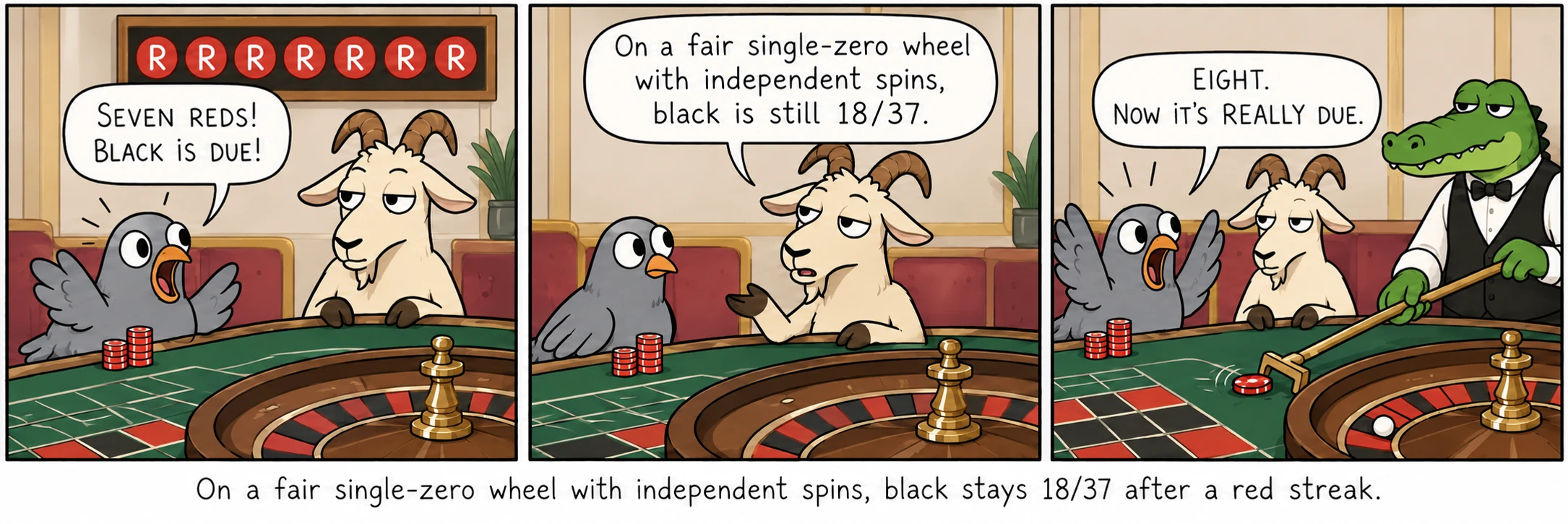
On a fair single-zerotaarordeSeeroSuudu haako wootere nde hay pari njoɓdi fotndi, sappo e ɗiɗi walla kolon kuuɓataa; ko ɗum woni iwdi ɓural kasino. Ina noddee kadi: seero gooto, 0.Tar fof → wheel, the next spin is red with probability 18/37 and black with probability 18/37. The streak gives neither bet an advantage; you can also choose not to bet.
A streak alone does not establish bias. A bias toward red could affect red streaks, but streaks also occur on fair wheels. Use an appropriate statistical test, account for how the pattern was selected, and seek independent confirmation.
Weltaare e Matematik
Etu ɗum hoore maa adii. Kala jaabawol ina suuɗii; uddit ɗum so a heblii.
Taarle taarorde Orop njelu ngoni e hakkundeere ngam limooje 37 ɗee fof yaltude kala e majje laabi gooto tal?
Hollu jaabawol ngol
Jaabawol Hono taarle 155 e hakkundeere; medyan ko 147.
Limtu fadde nde limoore hesere wootere e wootere. Taarol adanngol ina holla limoore hesere sahaa fof. So a yi'ii limoore 1, cuuɗikuutorɗeSuuduGootel e cuuɗi 37 limoraaɗi e rotoor. Ina noddee kadi: wenndu, kopp.Tar fof → 36 e nder 37 ko kese, ɗum waɗi limoore hesere garoore ndee ina naamnoo taarle 37/36 e hakkundeere. So a yi'ii limooje k, ina naamnoo 37/(37 − k).
Ɓeydin fadde ɗee: 37/37 + 37/36 + 37/35 + … + 37/1 = 37 × (1 + 1/2 + 1/3 + … + 1/37) ≈ 37 × 4,20 = 155,5 taarle.
Ko ɓuri heewde e majji ko gasirde ndee. Limoore sakkitiinde ndee tan ina naamnoo taarle 37 e hakkundeere, ɗe joy sakkitiiɗe ɗee hono 85. E taarorde Amerik, ɓeydondiral gootal ngal ina addi hono 161. Ɗum ko caɗeele moɓtoowo kupon; hakkundeere wootere nde ina yalta e limngal ganndaangal.
E taarle 37 taarorde Orop, taarol gootol e kala suudu, limooje ceertuɗe njelu fodaa yi'ude?
Hollu jaabawol ngol
Jaabawol Hono 23,6. Hono tataɓal limooje ɗee, hono 13, ɗe njaltataa fey.
Take one number, say 17. On each spin it fails to come up with chance 36/37, so it misses all 37 spins with chance (36/37)³⁷ ≈ 0.363.
Every number has the same chance, so on average 37 × 0.363 ≈ 13.4 numbers are missing and 37 − 13.4 ≈ 23.6 come up, many of them twice or more.
Roulette players call this the law of thirds. It is no law, only the arithmetic of repeats: in a run as long as the wheel, about a third of the numbers sit out, on a fair wheel; a biased wheellaboratuwaarTaarorde ooñiindeTaarorde nde ŋakkeeli mum ɗi fiisik waɗi cuuɗi goɗɗi ina ɓura yaltude 1/37. Ina woowaa, anndetaake si wonaa e taarle ujunaaje winndaaɗe.Tar fof → can give a different expected count. On 38 pockets the share is (37/38)³⁸ ≈ 0.363 too; for a large wheel it settles near 1/e ≈ 0.368.
Sehil maa ina holla ma doggol ɗiɗi nooneeji 50, boɗeerepariBoɗeerePari njoɓdi fotndi e limooje 18 boɗeeje. E Farayse: rouge.Tar fof → walla ɓaleerepariƁaleerePari njoɓdi fotndi e limooje 18 ɓaleeje. E Farayse: noir.Tar fof →, kala e majji ina wiyee ko iwi e taarorde ɗe seerotaarordeSeeroSuudu haako wootere nde hay pari njoɓdi fotndi, sappo e ɗiɗi walla kolon kuuɓataa; ko ɗum woni iwdi ɓural kasino. Ina noddee kadi: seero gooto, 0.Tar fof → accaama. Gootol ngol ina waylita noone laabi 25, jokkondiral mum ɓurngal juutde ko jeegom. Goɗngol ngol ina waylita laabi 35, ɓurtaani tati fey. Hol ngol tafaa?
Hollu jaabawol ngol
Jaabawol Ɗimmol ngol. Doggol goonga ina waylita hono laabi 24 walla 25. Ngol waylitii laabi 35 ina yalta hono laabi gooto e nder doggi 500, ngol alaa jokkondiral ɓurngal tati hono laabi ɗiɗi e nder 100.
Each new color either repeats the last one or switches, half and half, so 49 chances to switch give 24.5 switches on average, give or take about 3.5. Thirty-five is three standard deviationsmatematikSeerndu ndenndaanduRaasin karee wariyaas; ko woɗɗeende aadanteende njeñtudi e njaru fodaandu.Tar fof → above the mean. The exact probabilitymatematikPorobabiliteSahaa njeñtudi, immorde 0 haa 1 walla 0% haa 100%. Limoore wootere: 1/37 = 2,70%.Tar fof → of 35 or more switches is about 0.19%, roughly 1 in 526.
The runs tell the same story. A list of 50 independent fair colors has a run of four or more about 98% of the time, and its longest run is most often five or six.
These are separate checks of the switch count and longest run, not a combined probability or proof that a list was invented. Choosing a test after inspecting a list also affects how its result should be interpreted.
Deftere taariki kasino ina yeewta fijoowo mo limoore mum yalti laabi joy e jokkondiral, ina noddira ɗum rekoor. Ko honno ɗum hewtortoo e taarorde Orop? Hol no ɗum foti waɗirde nde kala e nder kasino gooto joginɗo taabalji 20, kala e majji ina taarna laabi 40 e kala waktu, ñalawma e jemma?
Hollu jaabawol ngol
Jaabawol Limoore innaande yaltude laabi joy e jokkondiral: 1 e nder 69 miliyoŋ. Kala limoore yaltude laabi nay goɗɗe caggal nde yalti adii: 1 e nder 1,87 miliyoŋ. Kasino oo ina taarna hono 7 miliyoŋ laabi e hitaande, ɗum waɗi ina foti yi'ude jokkondiral joy laabi tati walla nay e hitaande.
Limoore innaande ina yalta e porobabilite 1/37 e kala taarol, ɗum waɗi joy e jokkondiral ina jogii porobabilite (1/37)⁵ = 1 e nder 69 343 957. Kono alaa mo inndata limoore ndee adii. Ko yalti adii fof, taarle nay garooje ɗee ina poti fillitaade: (1/37)⁴ = 1 e nder 1 874 161.
Taabalji 20 × taarle 40 × waktuuji 24 × ñalɗi 365 = taarle 7 008 000 e hitaande. Kala taarol ina waawi fuɗɗude jokkondiral, ɗum waɗi kasino oo ina fodaa 7 008 000/1 874 161 ≈ 3,7 jokkondire joy e hitaande.
Alaa rekoor laawɗinaaɗo e ɗum, ɗum alaa nafoore: huunde seeɗa e taabal gootal ko huunde ñalawmaare e kasino fof, taariki ɗee ina yeewtee e taabal ngal ɗum waɗi heen. Taariki oo, e Goldman (2007), ina waɗi e taarorde seero ɗiɗi, ɗo limooje ɗee ngoni 1 e nder 79 miliyoŋ e 1 e nder 2,09 miliyoŋ.
Ƴeewndo weltinoowo
Jokkondire juutɗe ko no sahaa mbaaditiri.
Iwdi
- Feller, W. An Introduction to Probability Theory and Its Applications, Vol. 1.
- Ethier, S. N. The Doctrine of Chances: Probabilistic Aspects of Gambling.
- Taylor, D. G. Games, Gambling, and Probability: An Introduction to Mathematics, 2nd ed.