Caɗeele: Keerol Taabal
Martingale $10 e taabal $500. No ɗum heewiri helde, ko foti ɗum majjinta so helii, e mbele ɓantude keerol ngol ina walla?
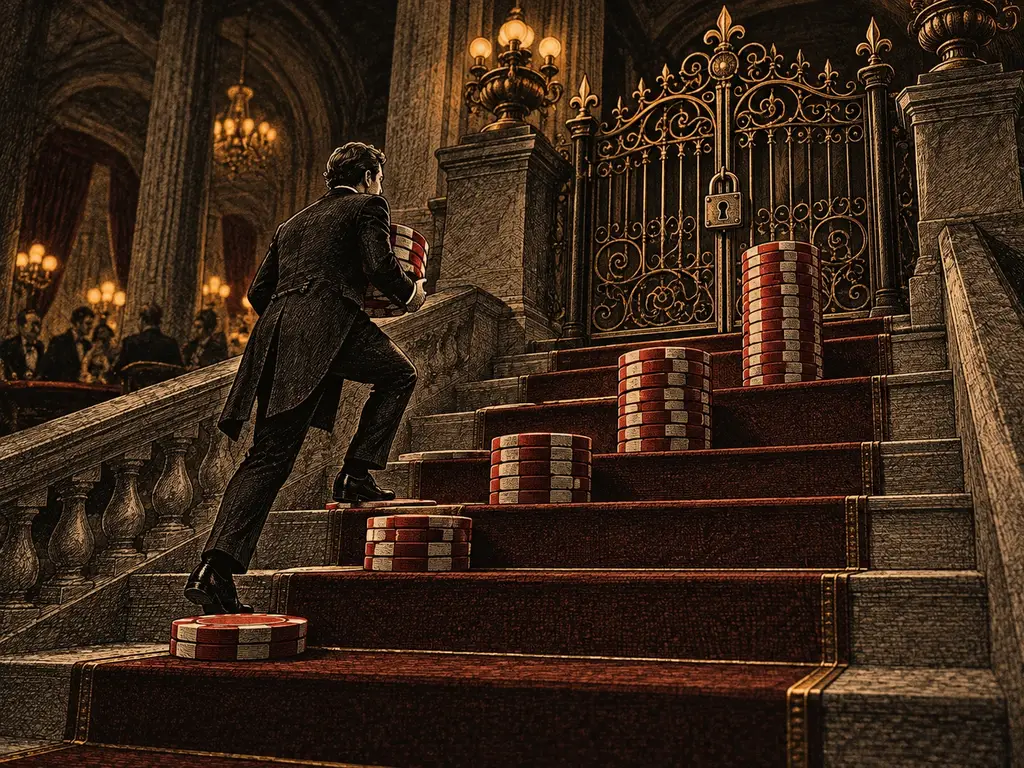
Majjeeje jeegom jokkondirɗe ina kela ɗum: 1,8% e daawal kala, hono 60% jonɗe taarle 100. Helde ngal ina coggoo $630. Ɓantude keerol ngol haa $5 000 ina ɓura ustude helde ngal (0,25% e daawal kala) ina ɓura mawninde ngal ($5 110). Majjere fodaande e dolaar kala pariyaaɗo ko 2,70% e kala keerol.
Caɗeele ɗee
Assume independent spinsmatematikTaarle ceertuɗeKala taarol ina jogii porobabiliteeji gooti, no ko ɓenni wayiri fof. Ko ɗum woni ɓuuɓre kala hasbugol e lowre ndee.Tar fof → and standard single-zerotaarordeSeeroSuudu haako wootere nde hay pari njoɓdi fotndi, sappo e ɗiɗi walla kolon kuuɓataa; ko ɗum woni iwdi ɓural kasino. Ina noddee kadi: seero gooto, 0.Tar fof → payoutskaalisNjoɓdiKo pari dañndi ruttata, wiyaa “X e 1” ɓeydaa e pari ruttaaɗo.Tar fof →, with enough bankrollkaalisKaalis pariKaalis fof ko seŋaa ngam fijde. Toppitagol kaalis pari ko ñaawde ko foti waɗeede e kala pari e kala jonnde.Tar fof → to fund each permitted stake. A player bets $10 on redpariBoɗeerePari njoɓdi fotndi e limooje 18 boɗeeje. E Farayse: rouge.Tar fof → and doubles after each loss, resetting after a win. The table maximum is $500. (a) How many consecutive losses break the progressiondabareJokkondiral pariKala sariya waylowo pari e njeñtuɗi ɓennuɗi. Jokkondiral caggal majjere ina ɓeyda pari caggal majjere, caggal dañal ina ɓeyda ɗum caggal dañal.Tar fof →? (b) What is the probabilitymatematikPorobabiliteSahaa njeñtudi, immorde 0 haa 1 walla 0% haa 100%. Limoore wootere: 1/37 = 2,70%.Tar fof → per cycle? (c) What is lost at the break? (d) How does a $5,000 limit change the answers? (e) Does any limit make the system profitable?
Jaabawol (a)–(c)
Pariiji: 10, 20, 40, 80, 160, 320. Jeeɗiɗaɓo oo ina wonnoo 640 > 500, ɗum noon majjeeje jeegom ina kela ɗum. (b) p(majjere) = 19/37 e boɗeere; (19/37)⁶ = 0,0183, hono 1,8% e daawal kala. Daawal ina juuta hono taarle ɗiɗi e hakkundeere, ɗum noon jonnde taarle 100 ina jogii hono daawe 50 e p(helde gootol ko famɗi fof) ≈ 1 − 0,9817⁵⁰ ≈ 60%. (c) 10 + 20 + 40 + 80 + 160 + 320 = $630, ɗum ko initeejikaalisInitePari fuɗɗoode mo sistem walla fijoowo gollirta. Jokkondirɗe pari ina cifee e initeeji ngam ɗi kuutoroo e kala taabal.Tar fof → fuɗɗorde 63, e $10 ɗo daawal ngal ina etoo dañde.
Jaabawol (d)
At $5,000: stakes to 2,560 are allowed; the tenth stake, 5,120, is refused. Nine losses break it: (19/37)⁹ ≈ 0.25% per cycle, about 11% of 100-spin sessions. Loss at the break: 10 + 20 + … + 2,560 = $5,110. The player has bought a rarer catastrophe at the price of a larger one. Over many sessions the expected cost of breaks is p × loss ≈ 0.0183 × 630 = $11.5 per cycle at the $500 limit and 0.0025 × 5,110 = $12.8 at $5,000; each is the expected contribution from failed cycles. Subtract the expected profit from successful cycles, $10 × (1 − p), to obtain total expected lossmatematikMajjere fodaandeNjaru fodaandu fiyaandu e kaalis pariyaaɗo fof; ko hakkundeere kaalis majjataako nder jonnde walla nder sahaa.Tar fof → per cycle: about $1.74 and $2.71 respectively.
Jaabawol (e)
With a finite limit and a well-defined stopping rule, expected loss equals expected turnoverkaalisKaalis pariyaaɗo fofKawrital kaalis pariyaaɗo nder jonnde walla sahaa, limtaa kadi kaalis dañaaɗo pariyaaɗo kadi. Ina noddee kadi: handle, action.Tar fof → divided by 37. Changing the limit can change turnover substantially. For the 100-spin examples below, the player resets to $10 after either a win or a failed progression, and has enough money to place every bet. These are exact model expectations, not a simulation. The imaginary unlimited-bankroll, unlimited-stake MartingaledabareMartingaleJokkondiral pari ɓeydoowo pari ɗiɗi laabi caggal kala majjere. Ƴeew hello Dabareeji ngam anndude ko ngal waɗata e ko ngal waɗataa.Tar fof → is different: a single cycle eventually wins $10 with probability 1, but its expected turnover is infinite. The finite-expectation identity cannot be applied to that unbounded stopping problem. Real bankrolls and tables cannot implement it.
Taabalji goonga ɗiɗi
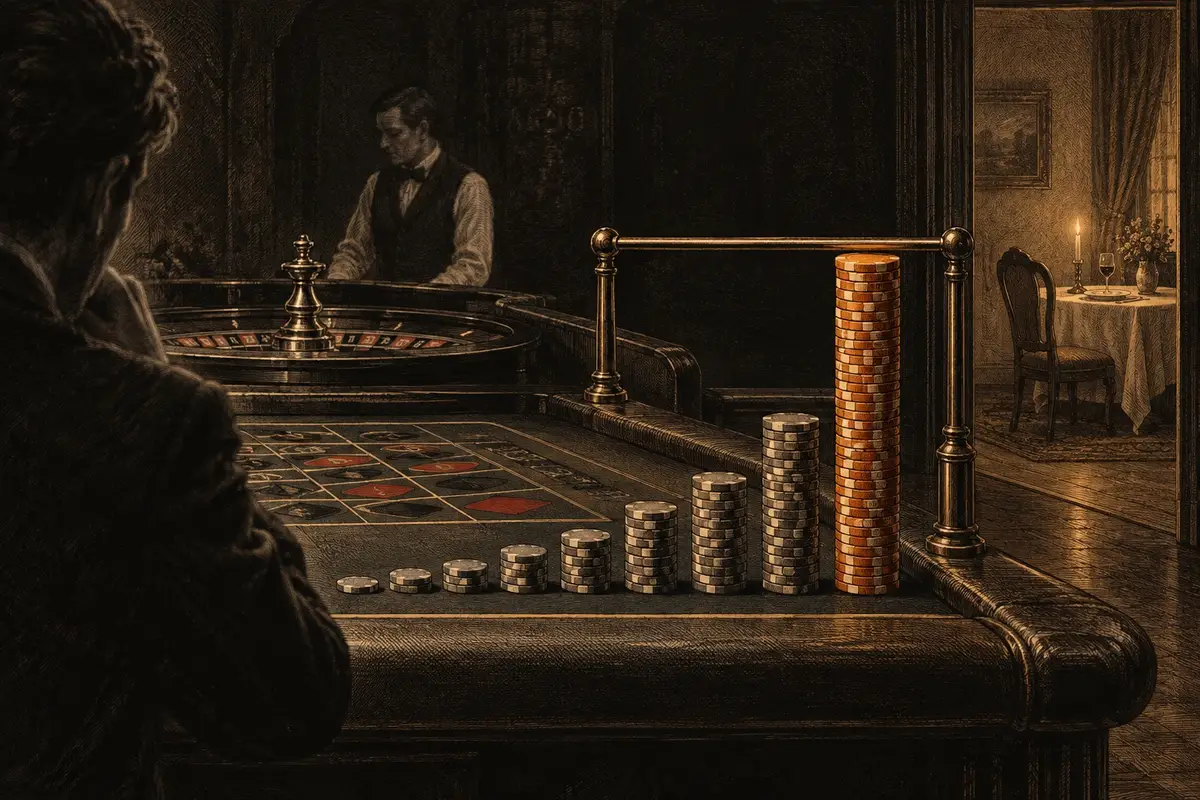
Misal Thorp ko taabal $1 jogiiɗo keerol dow $1 000, ɗo fijoowo ina tama dañde $30 ngam hiraande, dolaar e dolaar. Pariiji 1, 2, 4 … 512 ina njaɓa pariiji sappo, ɗum noon majjeeje sappo jokkondirɗe ina kela jokkondiral ngal: laabi gooto e nder daawe 785 e taarorde Orop (laabi gooto e nder 613 e taarorde Amerik), e coggu $1 023. Daawe capanɗe tati ɗee fof ina ndaña 96,2% sahaa. 3,8% goɗɗe ɗee ina majjina hono $1 000, njeñtudi hakkundeeri kiikiiɗe ɗee ko −$9,17, ɗum ko tigi 1/37 $339 ɗo daawe capanɗe tati ɗee ina mbaɗa pari e hakkundeere. Taabal $5 jogiiɗo keerol dow $2 000 ceertaani: pariiji haa $1 280 ina njaɓa pariiji jeenay, helde ngal ina waɗa laabi gooto e nder daawe 403 e taarorde Orop (laabi gooto e nder 323 e taarorde Amerik), ina coggoo $2 555.
Fijoowo galo
The table maximum is only one constraint. The player may run out of money before reaching it. A simulation must state whether it stops, resets to the base stake or bets the remaining balance when the next double is unaffordable. Those choices change session probabilities, so results from one rule cannot describe every Martingale strategy.
Ekkitinol ngol
A higher limit permits rarer but larger failed progressions. It does not remove the negative expectation of each standard bet, and it may increase the amount wagered. Compare the total exposure and stopping rule as well as the chance of a short winning cycle.
Formil
Naamne
Ina waawna ma hiswude haa keerol ɓurngol toownude, ɗo helde ngal ɓuri famɗude e ɓuri mawnude. Majjere fodaande e dolaar kala waylitaaki.
Pariiji 10, 30, 70, 150, 310: keerol $500 ina yettinee caggal majjeeje joy, helde ngal ina coggoo $570. 2,70% gooto oo.
A maximum limits the payout exposure accepted on a bet. The operator sets the actual limits; their existence does not create roulette’s house edgematematikƁural kasinoGeɗal kala pari ngal kasino jogiiyata e hakkundeere: 2,70% e ruleet Orop.Tar fof →.
Weltaare e Matematik
Etu ɗum hoore maa adii. Kala jaabawol ina suuɗii; uddit ɗum so a heblii.
A MartingaledabareMartingaleJokkondiral pari ɓeydoowo pari ɗiɗi laabi caggal kala majjere. Ƴeew hello Dabareeji ngam anndude ko ngal waɗata e ko ngal waɗataa.Tar fof → starts at $100 on redpariBoɗeerePari njoɓdi fotndi e limooje 18 boɗeeje. E Farayse: rouge.Tar fof → and allows itself at most n bets a cycle: after n losses in a row it gives up and starts again. Write the average result of one cycle as a formula in n, and work it out for 5, 6 and 7 bets on a European wheel. Assume independent uniform single-zerotaarordeSeeroSuudu haako wootere nde hay pari njoɓdi fotndi, sappo e ɗiɗi walla kolon kuuɓataa; ko ɗum woni iwdi ɓural kasino. Ina noddee kadi: seero gooto, 0.Tar fof → results and sufficient funds for every permitted stake.
Hollu jaabawol ngol
Jaabawol Hakkundeere ndee ko 100 × (1 − (38/37)ⁿ): −$14,26 ngam pariiji 5, −$17,35 ngam 6 e −$20,52 ngam 7. Yamirde pariiji ɓurɗi heewde ina bonna taarngal hakkundeejo, ina moƴƴintaa ɗum.
A cycle wins $100 unless all n bets lose, which happens with chance qⁿ, where q = 19/37. When they all lose, the stakes 100, 200 … 100 × 2ⁿ⁻¹ add up to 100 × (2ⁿ − 1). So the average is 100 × (1 − qⁿ) − 100 × (2ⁿ − 1) × qⁿ = 100 × (1 − (2q)ⁿ).
Here 2q = 38/37, a little more than 1, so (2q)ⁿ grows with n and the average falls: n = 5 gives 1.1426 and −$14.26; n = 6 gives 1.1735 and −$17.35; n = 7 gives 1.2052 and −$20.52. A longer ladder loses less often, in 3.6%, 1.8% and 0.9% of cycles, but each loss is twice as large, and more money crosses the table each cycle, at 2.70% of every bet.
On an American wheel 2q = 40/38 and the figures are −$29.24, −$36.04 and −$43.20. In a game with no zero 2q = 1, and every cycle averages exactly zero however long the ladder.
“Martingale mawngal” ina ɗiɗiɓina pari ngal caggal majjere ina ɓeyda initekaalisInitePari fuɗɗoode mo sistem walla fijoowo gollirta. Jokkondirɗe pari ina cifee e initeeji ngam ɗi kuutoroo e kala taabal.Tar fof → wootere, ɗum waɗi pariiji ɗii ina njaha 1, 3, 7, 15, 31 … Initeeji njelu ɓeydi-ɗaa so dañal adanngal arii e pari 1ɓiingal, 2ɓiingal, 3ɓiingal walla kɓiingal? E inite $10 e keerol dow $500, taarngal ina hella laabi njelu, taarngal ina coftina no foti e hakkundeere?
Hollu jaabawol ngol
Jaabawol Dañal e pari kɓiingal ina accoo ma ɓeydi initeeji k: +1, +2, +3 e ko nanndi e ɗum. E $10 e $500 taarngal ina hella caggal majjeeje joy, 3,57% taarɗe, ngam −$570. E hakkundeere taarngal ina majjina $2,32 e nder $85,73 pariyaaɗo: 2,70%.
The kth stake is 2ᵏ − 1 units: 1, 3, 7, 15, 31. The first k − 1 stakes add up to 2ᵏ − 2 − (k − 1) = 2ᵏ − k − 1. A win on the kth bet pays 2ᵏ − 1, so the cycle ends (2ᵏ − 1) − (2ᵏ − k − 1) = k units up: one extra unit for every loss before the win.
At least $570 is needed to fund all five stakes in a fresh cycle. At $10 a unit the stakes are $10, $30, $70, $150 and $310; the next, $630, is over the $500 maximum. Five losses in a row, (19/37)⁵ = 3.57%, cost 10 + 30 + 70 + 150 + 310 = $570.
Average: the wins bring in $10 × k with chance (19/37)ᵏ⁻¹ × 18/37 for k = 1 to 5, and the break takes $570 with chance 3.57%; together −$2.32. The money staked averages $85.73 a cycle, and 2.32/85.73 = 2.70%. The ordinary Martingale at the same table breaks after six losses, 1.83% of cycles, for −$630, and loses $1.74 out of $64.20 staked: 2.70% again.
Fijoowo ina faandii Martingale e boɗeere e pari adanngal $1 e taabal mo keerol mum woni $1 000, ɗum waɗi pariiji sappo ina mbaawi waɗude: $1, $2, $4 e ko nanndi e ɗum haa $512. Taarngal ina majjina sappo ɗii fof laabi njelu, ɗum ina naamnoo no foti e hakkundeere, kiikiiɗe pariiji 200 ina gasira nii laabi njelu?
Hollu jaabawol ngol
Jaabawol Taarngal ina majjina sappo ɗii fof hono laabi gooto e nder 784, ɗum ina coftina $1 023. Ɗum ko hono pariiji 1 600 e hakkundeere, kiikiiɗe pariiji 200 ina fiyoo e keerol ngol hono 11% sahaa. Taarngal ina majjina tan $0,31 e hakkundeere e nder $11,31 pariyaaɗo: 2,70%.
Pari e boɗeere ina majja e porobabilite 19/37, seero ina e nder. Sappo e jokkondiral: (19/37)¹⁰ ≈ 0,00128, hono 1 e nder 784. Pariiji 1 + 2 + 4 + … + 512 ina ɓeydondira haa $1 023.
Taarngal ina naamnoo pariiji 2,05 e hakkundeere, ɗum waɗi taarɗe 784 ina naamnoo hono pariiji 1 600. So limtaama taarol e taarol, jokkondiral majjeeje sappo ina feeñoo nokku e nder pariiji 200 11,3% sahaa.
Hakkunde musibaaji ɗii fijoowo oo ina daña $1 e kala taarngal: hono $783 hade bonngal ngal, ndeen −$1 023, hono −$240 e juuteendi ndii fof. E kala taarngal: 1 × (1 − 0,00128) − 1 023 × 0,00128 ≈ −$0,31. Kaalis pariyaaɗo e kala taarngal: 1 + 2 × (19/37) + 4 × (19/37)² + … + 512 × (19/37)⁹ ≈ $11,31. E −0,31/11,31 = −2,70%.
Yerondir pari adanngal $10 e keerol $500, pariiji jeegom: keerol ngol ina fiyoo laabi gooto e nder taarɗe 55, kiikiiɗe pariiji 200 ina hawra e mum 84% sahaa. Keerol ɓurngol toowde ina waɗa hellugol ngol ɓuri seeɗa e ɓuri mawnude, ɓurataa hoyde.
Ƴeewndo weltinoowo
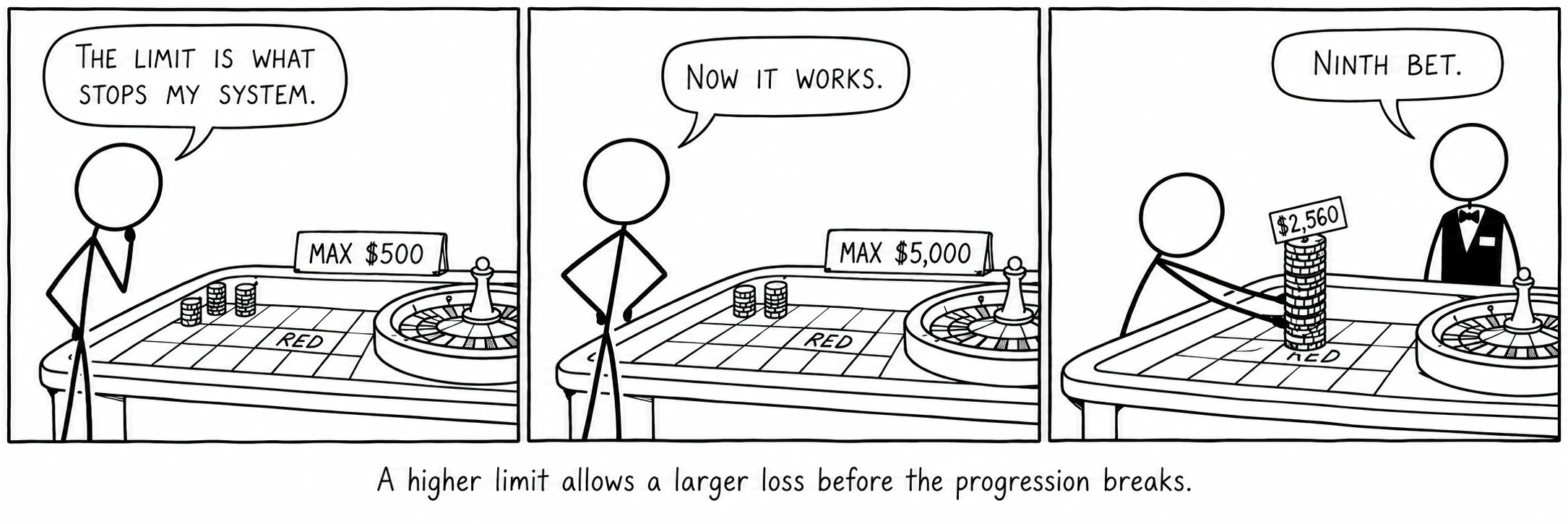
Ɓuri famɗude e ɓuri mawnude, e kala keerol. Fiilsugol mum ina tabiti.
Iwdi
- Ethier, S. N. The Doctrine of Chances: Probabilistic Aspects of Gambling.
- Thorp, E. O. “Optimal gambling systems for favorable games.”
- Thorp, E. O. The Mathematics of Gambling.
- Epstein, R. A. The Theory of Gambling and Statistical Logic, 2nd ed.