Ɓural Kasino e Ruleet
Feccere kala pari nde kasino jogotoo e hakkundeere.
Ruleet Orop: 2,70% e kala pari aadanteengal, sabu njoɓdi ina hiisaa hono cuuɗi ina 36 kono ko 37 woodi.
Ko ɗum iwi
Njoɓdi potndi ngam limoore wooterepariLimoore wootereLimoore wootere tan, ina yoɓa 35:1.Tar fof → ina foti wonde 36 e 1, sabu laabi 36 majjere ina ngoodi e kala laawol gootol dañal. Kasino ina yoɓa 35 e 1. InitekaalisInitePari fuɗɗoode mo sistem walla fijoowo gollirta. Jokkondirɗe pari ina cifee e initeeji ngam ɗi kuutoroo e kala taabal.Tar fof → majjunde ndee, feccaande e njeñtuɗi 37 potɗi sahaa, ko 1/37 = 2,70% pari e kala taarol. Ndeen ustaare ina wona e kala njoɓdikaalisNjoɓdiKo pari dañndi ruttata, wiyaa “X e 1” ɓeydaa e pari ruttaaɗo.Tar fof → sabu kala njoɓdi ina huutoroo sariya 36/n − 1: limooje ɗiɗipariLimooje ɗiɗiLimooje ɗiɗi takkondirɗe, ina yoɓa 17:1.Tar fof → ina yoɓa 17 nokku 17,5, sappo e ɗiɗipariSappo e ɗiɗi1–12, 13–24 walla 25–36, ina yoɓa 2:1.Tar fof → 2 nokku 2,083, boɗeerepariBoɗeerePari njoɓdi fotndi e limooje 18 boɗeeje. E Farayse: rouge.Tar fof → 1 nokku 1,056. Ceergal ngal ko kala sahaa 1/n inite e kala dañal, e dañe n/37 e kala taarol, ɗuum waɗi kala sahaa ko 1/37 e kala taarol.
Ɓural e ko kasino jogii
House edgematematikƁural kasinoGeɗal kala pari ngal kasino jogiiyata e hakkundeere: 2,70% e ruleet Orop.Tar fof → is expected lossmatematikMajjere fodaandeNjaru fodaandu fiyaandu e kaalis pariyaaɗo fof; ko hakkundeere kaalis majjataako nder jonnde walla nder sahaa.Tar fof → divided by the amount wagered. Table-game hold compares actual casino win with the money bought in or dropped, depending on the reporting definition. They have different denominators. Completing 200 standard single-zerotaarordeSeeroSuudu haako wootere nde hay pari njoɓdi fotndi, sappo e ɗiɗi walla kolon kuuɓataa; ko ɗum woni iwdi ɓural kasino. Ina noddee kadi: seero gooto, 0.Tar fof → spins at $10 creates $2,000 of turnoverkaalisKaalis pariyaaɗo fofKawrital kaalis pariyaaɗo nder jonnde walla sahaa, limtaa kadi kaalis dañaaɗo pariyaaɗo kadi. Ina noddee kadi: handle, action.Tar fof → and an expected loss of $54.05. The actual loss may be very different, and a $100 starting bankrollkaalisKaalis pariKaalis fof ko seŋaa ngam fijde. Toppitagol kaalis pari ko ñaawde ko foti waɗeede e kala pari e kala jonnde.Tar fof → may run out before all 200 spins are completed.
Ko waɗi kala pari ina jogii ɓural gootal
Standard single-zero payouts follow 36/n − 1, which gives the same 1/37 expected loss per unit on each bet. A fair single-zero straight-up payout would be 36 to 1, giving neither side an expected profit. Other rules need separate calculations: the American five-number bet has a 7.89% edge, while la partagesariyaLa partageSariya Farayse: so seero yalti, feccere pari njoɓdi fotndi ina ruttee. Ina feccita ɓural kasino e pariiji ɗii haa 1,35%.Tar fof → reduces the edge on single-zero even-money betspariPari njoɓdi fotndiBoɗeere/ɓaleere, peccotaake/peccotoonde, mawɗe/tokooseeje. Limooje 18, ina yoɓa 1:1.Tar fof → to 1.35%.
Ko ɓural ruleet wonaa
It is not the probabilitymatematikPorobabiliteSahaa njeñtudi, immorde 0 haa 1 walla 0% haa 100%. Limoore wootere: 1/37 = 2,70%.Tar fof → of losing a session. For example, exactly 100 independent, fixed-stake bets on red on a fair single-zero wheel finish in profit about 35.53% of the time. The edge is not a fixed session fee: expected loss scales with the total amount wagered. Combining standard bets does not reduce it; their expected losses add.
E kaalis
Per $1,000 wagered the expected loss is $27.03 in European roulettefannuRuleet OropTaarorde seero gooto, cuuɗi 37, ɓural kasino 2,70%. Ko modeel ngol lowre ndee ƴettori.Tar fof →, $52.63 in American, $13.51 on even-money bets with la partage. Wagering $500 per session, twice a week for 52 weeks, creates $52,000 of turnover. On standard single-zero bets the expected loss is about $1,405; the actual result can differ substantially.
E kala taarol walla e kala pari taƴaaɗo
Standard roulette bets settle on one spin. A bet that stays on the layoutkuutorɗeTapiKaare pariiji winndaande e taabal. Ina noddee kadi: taabal, feetere, sanyo.Tar fof → after a push needs two measures: expected loss per spin and expected loss per completed bet. In the Riverboat Roulette rules described by Michael Shackleford, teal covers three of 38 pocketskuutorɗeSuuduGootel e cuuɗi 37 limoraaɗi e rotoor. Ina noddee kadi: wenndu, kopp.Tar fof → and pays 2:1. Eight white pockets lose; the other 27 outcomes push.
Assuming independent, equally likely outcomes and leaving the bet up until it settles, the expected loss is 2/11 of the original stake per completed bet (18.18%). While the bet is active, its expected loss per spin is 2/38 (5.26%). It takes an average of 38/11 spins to settle. To estimate an hourly cost, you also need the stake and the number of spins for which it stays active; neither percentage predicts an actual session result.
Nde kasino juumi e coggu
A payout error can give players a mathematical advantage. Hunacek (2025), citing Bollman, describes an October 1994 Grand Casino Biloxi bet paying 80 to 1 on three dice totaling 4. Three dice fall 216 ways and only 3 of them total 4, so the bet returned 81 × 3/216 = 1.125 for every unit staked: a 12.5% edge to the player. The account says the casino lost about $180,000 in a day and later lowered the payout to 60 to 1. That payout turns the same 3 chances in 216 into a 15.3% house edge. These historical details are a published account, not a result established by the calculation. The lesson is to calculate the expected return from the actual rules and payout table.
Pariiji sera e fijooji taabal goɗɗi
The examples below compare main bets with selected side betspariPari seraPari ɓeydaando suɓotoondo ƴowaando e fijo mawngo, ko ɓuri heewde e jokkondire, hewtere bonis walla jakpot. Ko ɓuri heewde ina ɓuri coggude pariiji laawol.Tar fof → described by Bollman (2021). In these examples, the blackjack, baccarat and craps side bets have higher edges than the main bets. That is not a rule for every side bet or every set of conditions. Colors and WINGO illustrate the reverse: their quoted edges are below the 5.26% on standard American roulettefannuRuleet AmerikTaarorde jogiinde 0 e 00, cuuɗi 38, ɓural kasino 5,26%. Wonaa modeel ngal lowre nde huutortoo.Tar fof → bets.
Formil
Naamne
Alaa. Ko 2,70% ko waɗ-ɗaa pari. Waɗde pari kadi e kaalis gootun ina waɗa ɗum pari laawol goɗngol.
Alaa. Ko feccere. Majjere fodaande e dolaaruuji ina ɓeydoo e pari.
So ɓural ngal ƴeewaama, pariiji aadanteeji Orop fof ina potti; ɗi ceertaa si wonaa e no ɗi ndañata sahaaji keewɗi e no ɗi njoɓata. E la partage, pariiji njoɓdi fotndi ko feccere goɗɗi ɗii.
Weltaare e Matematik
Etu ɗum hoore maa adii. Kala jaabawol ina suuɗii; uddit ɗum so a heblii.
On a fair single-zerotaarordeSeeroSuudu haako wootere nde hay pari njoɓdi fotndi, sappo e ɗiɗi walla kolon kuuɓataa; ko ɗum woni iwdi ɓural kasino. Ina noddee kadi: seero gooto, 0.Tar fof → wheel with standard payoutskaalisNjoɓdiKo pari dañndi ruttata, wiyaa “X e 1” ɓeydaa e pari ruttaaɗo.Tar fof →, why do a straight-up bet and redpariBoɗeerePari njoɓdi fotndi e limooje 18 boɗeeje. E Farayse: rouge.Tar fof → both have a house edgematematikƁural kasinoGeɗal kala pari ngal kasino jogiiyata e hakkundeere: 2,70% e ruleet Orop.Tar fof → of 1/37?
Hollu jaabawol ngol
Jaabawol Both return 36/37 of the stake on average, despite their different win probabilities.
For a one-unitkaalisInitePari fuɗɗoode mo sistem walla fijoowo gollirta. Jokkondirɗe pari ina cifee e initeeji ngam ɗi kuutoroo e kala taabal.Tar fof → standard bet covering n pocketskuutorɗeSuuduGootel e cuuɗi 37 limoraaɗi e rotoor. Ina noddee kadi: wenndu, kopp.Tar fof →, a win returns 36/n units including the stake. The win probabilitymatematikPorobabiliteSahaa njeñtudi, immorde 0 haa 1 walla 0% haa 100%. Limoore wootere: 1/37 = 2,70%.Tar fof → is n/37. Expected gross return is therefore (n/37)×(36/n)=36/37, leaving an expected lossmatematikMajjere fodaandeNjaru fodaandu fiyaandu e kaalis pariyaaɗo fof; ko hakkundeere kaalis majjataako nder jonnde walla nder sahaa.Tar fof → of 1/37, about 2.70%.
This covers the ordinary payout pattern. An American five-number bet, special payouts and French half-back even-money rules need their own calculations. Equal edges per unit do not mean equal risk or equal expected loss when the stakes differ.
Keno, fijo nanndungo e loto, ina jogii 25% walla ko ɓuri ɗum e ko pariyaa. Si kasino ɓeydii seeroji e taarorde ruleet, accii njoɓdi no wonnoo, seeroji njelu ngoni ngam ruleet coggoo hono keno?
Hollu jaabawol ngol
Jaabawol Seeroji sappo e ɗiɗi: taarorde cuuɗi 48.
With z zeros the wheel has 36 + z pockets, and the payouts still assume 36. By the rule in the puzzle above, every standard bet loses z units on average in 36 + z spins, so the house edge is z/(36 + z).
Set that equal to one quarter: 4z = 36 + z, so z = 12. Twelve zeros on a 48-pocket wheel would cost 25%.
A triple-zero wheel has one quarter of that many zeros; with standard payouts its house edge is 3/39, about 7.69%.
seerojicuuɗiɓural kasino1372,70%2385,26%3397,69%44010,00%124825,00%Suppose a uniform 36-number wheel has no zero. A single-number bet returns 25 for 1, while a $2 red bet returns $3 on a win. Red covers 18 numbers. Is this cheaper per dollar than standard single-zero roulette?
Hollu jaabawol ngol
Jaabawol Alaa, ina ɓuri coggude no feewi: 30,56% e limoore wootere e 25% e boɗeere walla ɓaleere, nde ruleet Orop woni 2,70%.
“For 1” includes the returned stake. A one-unit number bet has expected gross return 25/36, so the edge is 11/36, about 30.56%.
The $2 red bet returns $3 with probability one-half. Its expected return is $1.50 on $2 staked: a 25% edge.
Removing zero does not ensure a fair gamematematikFijo potngoFijo ngo hay sera wootere alaa ɓural: kala pari ina jogii njaru fodaandu potndu e seero.Tar fof →. Probabilities and payouts must be considered together. These are hypothetical terms, not a claim about a particular lottery product.
Kasino ina yiɗi pari keso e limooje aranndeejematematikLimoore aranndeereLimoore timmunde ɓurnde 1 nde 1 e hoore mayre tan peccata no feewi: 2, 3, 5, 7, 11, 13 e ko nanndi e ɗum.Tar fof → sappo e gooto hakkunde 1 e 36: 2, 3, 5, 7, 11, 13, 17, 19, 23, 29 e 31. Ko njelu foti njoɓeede ngam coggoo 2,70% wano pari kala e taarorde Orop? Ko ɗum coggata e 2 e 1?
Hollu jaabawol ngol
Jaabawol 25 e 11, hedde 2,27 e 1. E 2 e 1 ina coggoo 10,81%.
Use the rule from the first puzzle: a bet on n numbers pays (36 − n)/n to 1. With n = 11 that is 25/11 to 1, a fractional payout: a $10 stake would win $250/11, about $22.73, before any rounding rule.
At 2 to 1, a $1 bet wins $2 on 11 spins in 37 and loses $1 on the other 26: 22 − 26 = −4 units every 37 spins, 10.81%.
This is why roulette sells bets on 1, 2, 3, 4, 6, 12 and 18 numbers: 36 divides by each of them, so the standard payout is a whole number. These are not fair payouts on a 37-pocket wheel: fair odds would use 37 rather than 36.
Ƴeewndo weltinoowo
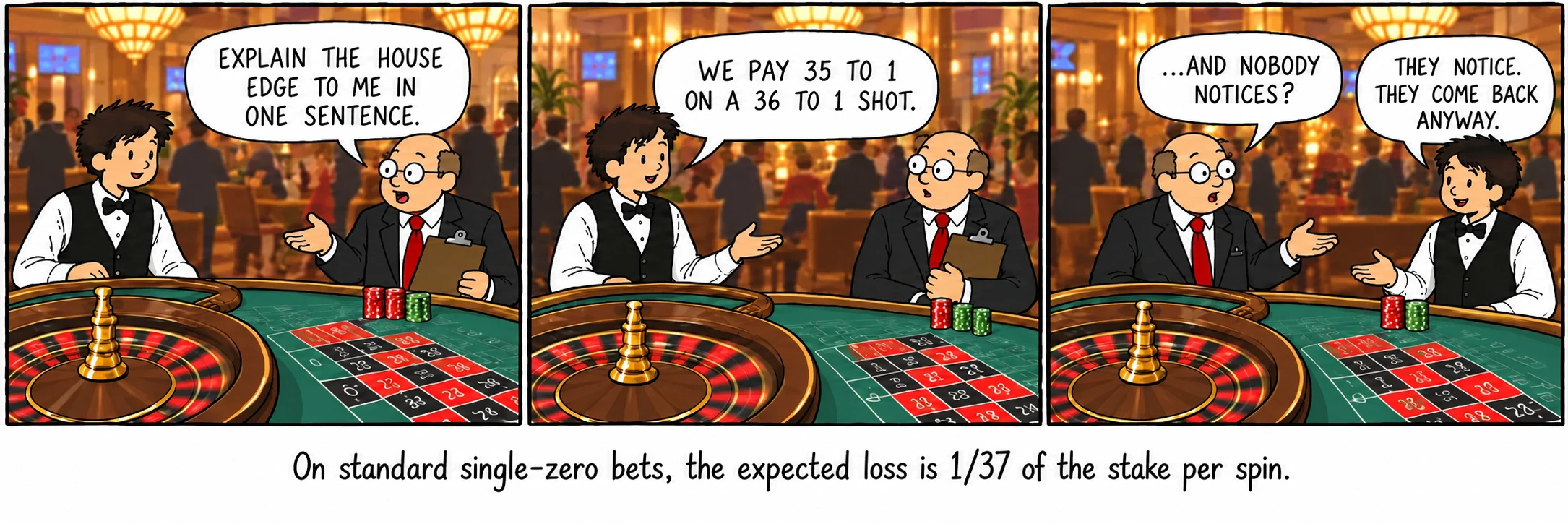
1/37 kala pari, e kala pari, e kala taarol.
Iwdi
- Ethier, S. N. The Doctrine of Chances: Probabilistic Aspects of Gambling.
- Epstein, R. A. The Theory of Gambling and Statistical Logic, 2nd ed.
- Bollman, M. Mathematics of the Big Four Casino Table Games: Blackjack, Baccarat, Craps, & Roulette.
- Hunacek, M. Quantitative Literacy Through Games and Gambling.