Seerndu Ndenndaandu e Ruleet
Seerndu ndenndaandu ruleet, daɗol kaaree wariyaasmatematikWariyaasPeeta no njeñtuɗi saŋkitiri e njaru fodaandu. Ina toowi ngam limoore wootere, ina lesɗi ngam pariiji njoɓdi fotndi.Tar fof →, ko woɗɗeende aadanteende hakkunde njeñtudi e ko fodaa.
Per $1 staked, σ is 5.84 for a straight uppariLimoore wootereLimoore wootere tan, ina yoɓa 35:1.Tar fof → and 1.00 for red. For independent spinsmatematikTaarle ceertuɗeKala taarol ina jogii porobabiliteeji gooti, no ko ɓenni wayiri fof. Ko ɗum woni ɓuuɓre kala hasbugol e lowre ndee.Tar fof → with the same bet and stake, multiply by the stake and the square root of the number of spins.
Sariya newɗo
When a normal approximation is suitable, about 68% of results lie within one standard deviationmatematikSeerndu ndenndaanduRaasin karee wariyaas; ko woɗɗeende aadanteende njeñtudi e njaru fodaandu.Tar fof → of the mean and 95% within two. These are approximations, not universal rules. For 100 independent $10 bets on redpariBoɗeerePari njoɓdi fotndi e limooje 18 boɗeeje. E Farayse: rouge.Tar fof →, the expected result is about −$27 and the standard deviation is $100. The exact binomial probabilities below account for the fact that final results come in $20 steps. An unusual session alone does not establish an advantage.
Ko waɗi √N
Expected lossmatematikMajjere fodaandeNjaru fodaandu fiyaandu e kaalis pariyaaɗo fof; ko hakkundeere kaalis majjataako nder jonnde walla nder sahaa.Tar fof → grows in proportion to N; spread grows in proportion to √N. For short sessions, random variation can be large compared with the expected loss. As N grows, expected loss becomes larger relative to that spread. The crossover, where expected loss equals one standard deviation, is at N = (σ/edge)². Using unrounded single-zerotaarordeSeeroSuudu haako wootere nde hay pari njoɓdi fotndi, sappo e ɗiɗi walla kolon kuuɓataa; ko ɗum woni iwdi ɓural kasino. Ina noddee kadi: seero gooto, 0.Tar fof → values gives 1,368 spins for even-money betspariPari njoɓdi fotndiBoɗeere/ɓaleere, peccotaake/peccotoonde, mawɗe/tokooseeje. Limooje 18, ina yoɓa 1:1.Tar fof → and 46,656 for straight-up bets. This is a comparison of scales, not a point at which outcomes become certain.
Huutoraade ɗum
To judge whether a session was unusual, compute (result − EV)/σ. A $10 red bettor who finishes 100 spins at +$160 has won 58 spins and lost 42. That result is about (160 + 27)/100 = 1.87 standard deviations above the mean. The exact probabilitymatematikPorobabiliteSahaa njeñtudi, immorde 0 haa 1 walla 0% haa 100%. Limoore wootere: 1/37 = 2,70%.Tar fof → of finishing at +$160 or better is about 3.82%. The z-score describes distance from the mean; use the actual outcome distribution to calculate a tail probability.
Juumre ndenndaande feccere
Limto gootol ngol ina hollaa no taarle foti ngam yi’ude ɓural ngal e keɓe ɗee. Juumre ndenndaande feccere dañe yiyaande ko √(p(1 − p)/N). E boɗeere e N = 1 000: √(0,4865 × 0,5135 / 1000) ≈ 1,6%. Ceergal hakkunde pees kaalis potɗo e boɗeere ko 1,35%, ɗuum waɗi caggal taarle 1 000 a waawataa tawo seerndude ɗum e hoolaare. Caggal 10 000 juumre ndenndaande ko 0,5% tawa a waawii. Ɗum kadi woni ko waɗi yiytude ooñol taarorde ina sokli taarle keewɗe no feewi.
Reenaade ooñol
Straight-up results are far from normally distributed in a short session: most sessions are a steady −$10 per spin with occasional +$350 jumps. The standard deviation remains valid, but the normal 68%/95% rule can be misleading. For even-money bets, the normal approximation becomes more useful as the number of spins grows; an exact binomial calculation avoids approximation error.
Formil
Naamne
Ko seedee wonde a fijii hedde jonɗe 40, walla a wonii e wootere jonnde sahaa e nder capanɗe nay. Fuɗɗito ɗum.
For independent spins with a fixed bet and stake, the standard error of the average is σ/√N. At 10,000 spins it is about 1% of the stake for red, but about 5.84% for a straight-up bet. The spread shrinks with N; the observed average need not move steadily toward its expectation.
Weltaare e Matematik
Etu ɗum hoore maa adii. Kala jaabawol ina suuɗii; uddit ɗum so a heblii.
E taarle 100 taarorde Orop, initekaalisInitePari fuɗɗoode mo sistem walla fijoowo gollirta. Jokkondirɗe pari ina cifee e initeeji ngam ɗi kuutoroo e kala taabal.Tar fof → wootere e boɗeerepariBoɗeerePari njoɓdi fotndi e limooje 18 boɗeeje. E Farayse: rouge.Tar fof → ina woni e dañal so dañii 51 tal, inite wootere e limoore wooterepariLimoore wootereLimoore wootere tan, ina yoɓa 35:1.Tar fof → ina woni e dañal so limoore mum yaltii laabi 3 tal. Huutoro kuurtol Gauss ngam hiinnaade porobabilite ɗiɗi ɗee, ndeen yerondir ɗe e jaabawuuji goonga ɗii.
Hollu jaabawol ngol
Jaabawol Boɗeere: kuurtol Gauss ina addi 35,6%, jaabawol goonga ngol ko 35,5%. Limoore wootere: kuurtol Gauss ina addi 55,0%, jaabawol goonga ngol ko 50,9%. Laawol ɓadngol ngol ina golla ngam boɗeere ina juuma ngam limoore wootere.
Boɗeere: dañe ɗee ina njogii hakkundeere 100 × 18/37 = 48,6, e senndugol √(100 × 18/37 × 19/37) = 5,0. Wonde e dañal ko 51 walla ko ɓuri; maande hakkundeere, 50,5, ko senndugol 0,37 ɓurngol hakkundeere ndee, kuurtol Gauss ina waɗa 35,6% dow ɗum. Ɓeydude porobabilite goonga dañe 51, 52 … 100 ina addi 35,5%.
Limoore wootere: hawrugol ina jogii hakkundeere 100/37 = 2,70, e senndugol √(100 × 1/37 × 36/37) = 1,62. Hawrugol tati walla ko ɓuri ina firta dow 2,5, senndugol 0,12 les hakkundeere ndee: 55,0% e kuurtol Gauss. E goonga, ko 1 ustaa porobabilite hawrugol 0, 1 e 2, 6,5% + 17,9% + 24,7%, ɗum ina acca 50,9%.
Kuurtol Gauss ina naamnoo njeñtuɗi keewɗi e ɓerɗe ɗiɗi hakkundeere ndee. Boɗeere ina jogii ɗi caggal taarle 100; limoore hawrata ko ɓuri famɗude laabi tati e hakkundeere jogaani ɗi. Kuurtol ngol ina rokka hay 8,7% “alaa hawrugol”, tawa porobabilite goonga ndee ko 6,5%. Taylor (2021) ina waɗa binomiyal e kuurtol Gauss ɓerɗe e ɓerɗe e laawol gootol ngol.
Ƴeewndo weltinoowo
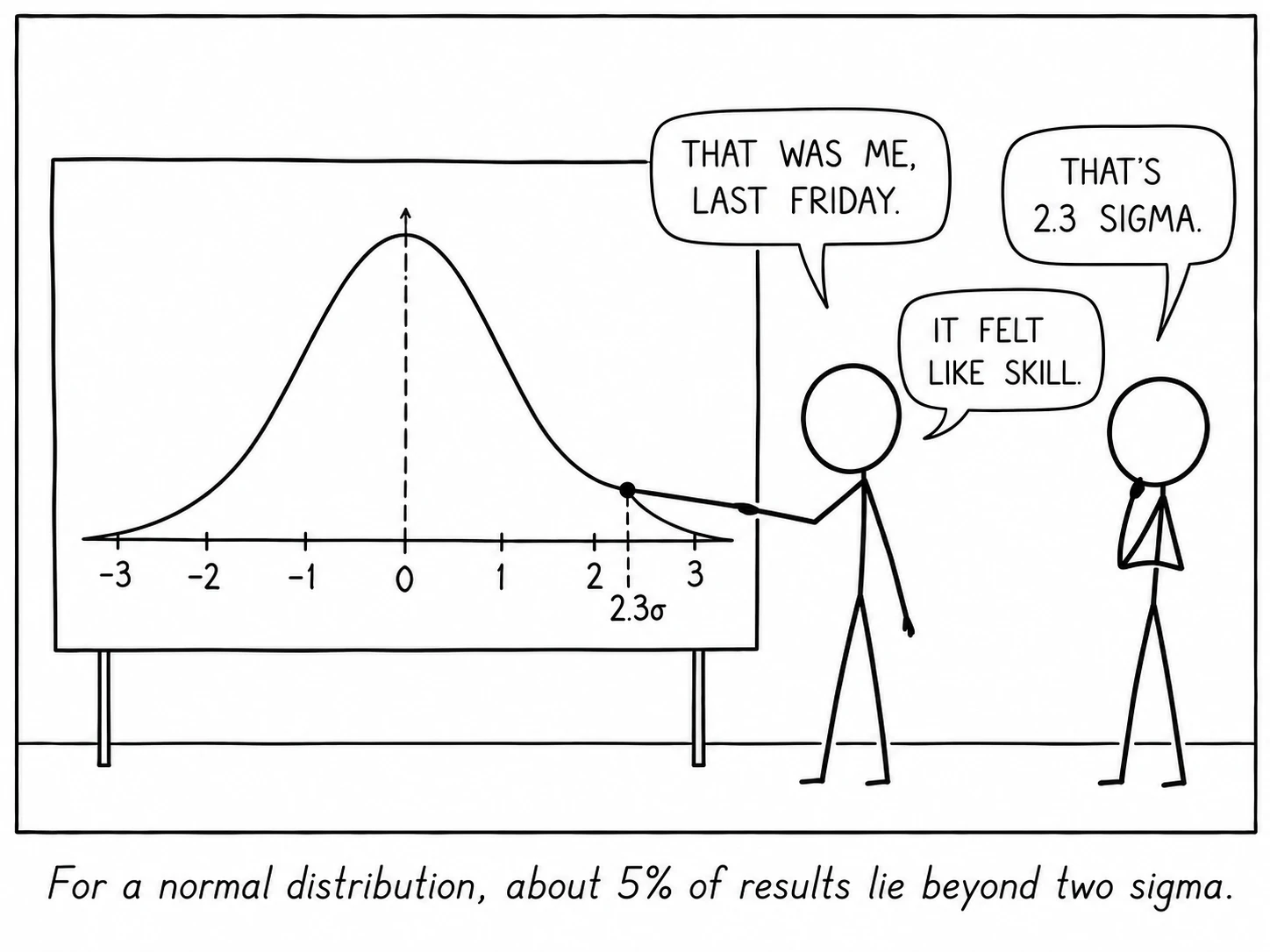
Under a normal approximation, about 5% of results lie more than two standard deviations from the mean.
Iwdi
- Feller, W. An Introduction to Probability Theory and Its Applications, Vol. 1.
- Ethier, S. N. The Doctrine of Chances: Probabilistic Aspects of Gambling.
- Taylor, D. G. Games, Gambling, and Probability: An Introduction to Mathematics, 2nd ed.