Miijo Juumɗo: Dabare Ruleet nde Dañata Sahaa Kala
“Mi jogii sistem dañoowal 80% e sahaaji.” Ina waawi. Kono ina majjina kaalis haa jooni.
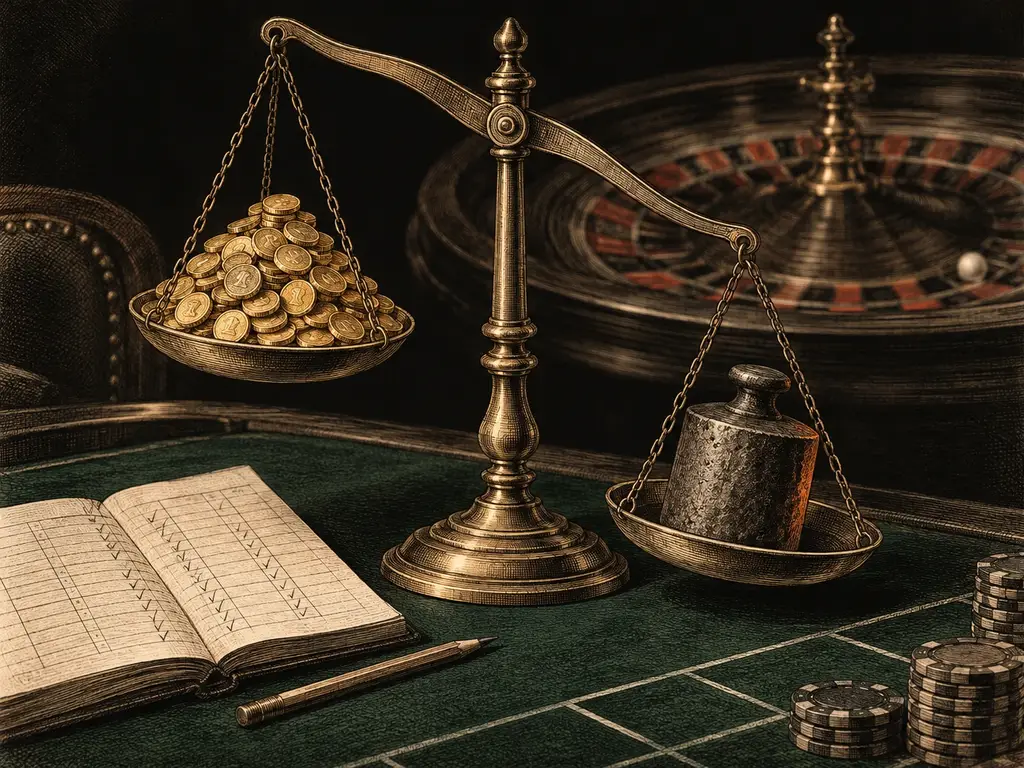
Sistem ina waawi waɗde jonɗe dañooje ina keewa. Waawaa waɗde njaru fodaandu wonta dañal, sabu kala pari ngo ngal waɗata ko −1/37 e pari mum tee njaruuji fodaaɗi ina kawroo. Sistemji ɓurɗi dañde ko heewi ko ɗi ɓuri majjinde so majjii.
Ko wiyetee
Gooŋɗinal ngal: ina woodi to woni dabare ruleet nde dañata sahaa kala, sistem pariiji waylotooji e ko arti ngal waylitta ruleet fijo dañoowo. Seedeeji hokkaaɗi: jokkondiral jonɗe dañooje, widewo e no dañirtee e ruleet sahaa kala, seedeeyaagal, tabalo hiisa yontere barkeende. Ko wiyetee ko goonga e ko ɓuri heewde; neɗɗo oo ina gooŋɗina ɗum sabu ina golliino.
Ko waɗi ɗum ko juumre, e laawol gootol
For an independent uniform single-zerotaarordeSeeroSuudu haako wootere nde hay pari njoɓdi fotndi, sappo e ɗiɗi walla kolon kuuɓataa; ko ɗum woni iwdi ɓural kasino. Ina noddee kadi: seero gooto, 0.Tar fof → model with standard full-loss-on-zero payoutskaalisNjoɓdiKo pari dañndi ruttata, wiyaa “X e 1” ɓeydaa e pari ruttaaɗo.Tar fof →, each unitkaalisInitePari fuɗɗoode mo sistem walla fijoowo gollirta. Jokkondirɗe pari ina cifee e initeeji ngam ɗi kuutoroo e kala taabal.Tar fof → staked has expected net return −1/37. In a bounded session, with bets chosen using information available before each spin, expected lossmatematikMajjere fodaandeNjaru fodaandu fiyaandu e kaalis pariyaaɗo fof; ko hakkundeere kaalis majjataako nder jonnde walla nder sahaa.Tar fof → is 1/37 of expected turnoverkaalisKaalis pariyaaɗo fofKawrital kaalis pariyaaɗo nder jonnde walla sahaa, limtaa kadi kaalis dañaaɗo pariyaaɗo kadi. Ina noddee kadi: handle, action.Tar fof →.
This statement needs its assumptions. Different payouts require a different edge, and an unbounded theoretical stopping rule cannot be handled by silently ignoring convergence conditions. A finite bankrollkaalisKaalis pariKaalis fof ko seŋaa ngam fijde. Toppitagol kaalis pari ko ñaawde ko foti waɗeede e kala pari e kala jonnde.Tar fof →, table limitstaabalKeerol taabalPari ɓurɗo famɗude e ɓurɗo mawnude jaɓaaɗo. Keerol dow ngol ko ngol dartinta jokkondirɗe pari ɓeydooje ɗiɗi laabi.Tar fof → and a defined stopping rule make a real system concrete enough to evaluate.
Ko waɗi ina wa'i no ina golla
Some progressionsdabareJokkondiral pariKala sariya waylowo pari e njeñtuɗi ɓennuɗi. Jokkondiral caggal majjere ina ɓeyda pari caggal majjere, caggal dañal ina ɓeyda ɗum caggal dañal.Tar fof → produce frequent small wins and occasional larger losses. The exact frequency depends on the bankroll, maximum stake, session length and reset rules. There is no universal 80% MartingaledabareMartingaleJokkondiral pari ɓeydoowo pari ɗiɗi laabi caggal kala majjere. Ƴeew hello Dabareeji ngam anndude ko ngal waɗata e ko ngal waɗataa.Tar fof → session-win rate.
For an illustrative comparison, suppose a session wins $40 with probabilitymatematikPorobabiliteSahaa njeñtudi, immorde 0 haa 1 walla 0% haa 100%. Limoore wootere: 1/37 = 2,70%.Tar fof → 80% and loses $500 with probability 20%. Its expected result is 0.8 × $40 − 0.2 × $500 = −$68. These assumed outcomes are not simulated results for a particular Martingale configuration.
Ƴeewndo ngo kala gooto waawi waɗde
The Strategy Simulator can help explore a specified configuration. Read its bankroll, bet rules, session length and stopping conditions before interpreting the output. A finite simulation can have a positive sample mean even when the theoretical expected return is negative. Repeatability and uncertainty matter; neither one winning session nor a simulation alone proves a universal claim.
Sistem ngal waawaa majjude
Not placing a wager avoids gambling losses. That is different from finding a betting method with a guaranteed profit. A rule advertised as risk-free may conceal this distinction, an uncovered outcome, a funding requirement or a limit it cannot satisfy.
Sistemji jogiiɗi inɗe, laawol gootol kala
Sistemji soodetengi e innde, walla no feere dañde e ruleet, ceertaaki. Kala e majji ko pariiji, tee kala pari ina yoɓa taarorde ndee 2,70% mum. Bollman (2024) ina hiisa won e majji e taarorde Amerik, ɗo kala gootol coggiri 5,26%; ɗoo ko e taarorde Orop.
Mbaadi goonga
Stake rules change the distribution of session results and the amount wagered. Under the stated model they do not create an advantage. A progression costs more in expectation than another plan only when it produces more expected turnover at the same house edgematematikƁural kasinoGeɗal kala pari ngal kasino jogiiyata e hakkundeere: 2,70% e ruleet Orop.Tar fof →; larger total stakes should not be assumed without comparing the plans.
Naamne
Lebbi jeegom jonɗe kala yontere ko hedde jonɗe 25. Martingale ina daña 80% e majji. Jonɗe majjooje ɗee ina ngara, tee ina ɓuri mawnude.
No. A stopping rule changes exposure and the distribution of results. It does not create positive expectation under the stated bounded-session model.
It could change the probability model if supported by evidence. That is different from merely changing stakes after independent results.
Weltaare e Matematik
Etu ɗum hoore maa adii. Kala jaabawol ina suuɗii; uddit ɗum so a heblii.
Sistem gaajaaje Mike Caro hitaande 1997 ngam taarorde Amerik ina haɗa boɗeerepariBoɗeerePari njoɓdi fotndi e limooje 18 boɗeeje. E Farayse: rouge.Tar fof → e ɓaleerepariƁaleerePari njoɓdi fotndi e limooje 18 ɓaleeje. E Farayse: noir.Tar fof →, peccotaake e peccotoonde, e seerojitaarordeSeeroSuudu haako wootere nde hay pari njoɓdi fotndi, sappo e ɗiɗi walla kolon kuuɓataa; ko ɗum woni iwdi ɓural kasino. Ina noddee kadi: seero gooto, 0.Tar fof →; limooje boɗeeje peccotaake e ɓaleeje peccotooje; limoore 30; e cuuɗikuutorɗeSuuduGootel e cuuɗi 37 limoraaɗi e rotoor. Ina noddee kadi: wenndu, kopp.Tar fof → fof e laawol iwde 11 rewde e laawol montoor haa 14. Huutoro sariyaaji ɗii gooto gooto. Limooje honɗe keddii ngam waɗde pari?
Hollu jaabawol ngol
Jaabawol None. It places no bets and has no gambling gain or loss; a house-edge percentage is undefined with zero turnoverkaalisKaalis pariyaaɗo fofKawrital kaalis pariyaaɗo nder jonnde walla sahaa, limtaa kadi kaalis dañaaɗo pariyaaɗo kadi. Ina noddee kadi: handle, action.Tar fof →.
Haɗde boɗeere, ɓaleere, peccotaake, peccotoonde e seeroji ina heddina limooje gooto gooto e mofte famɗuɗe hakkunde 1 e 36.
Alaa boɗeeje peccotaake, alaa ɓaleeje peccotooje ina heddina boɗeeje peccotooje (12, 14, 16, 18, 30, 32, 34, 36) e ɓaleeje peccotaake (11, 13, 15, 17, 29, 31, 33, 35): limooje sappo e jeegom. Haɗde 30 ina heddina sappo e joy.
E taarorde Amerik laawol iwde 11 rewde e laawol montoor haa 14 ina hawta cuuɗi 32 e 38. Jeegom ɗi ngonaa e mum ko 0, 28, 9, 26, 30 e 2. Sappo e joy keddiiɗe ɗee fof ina ngoni nder laawol ngol, ndeen sariya sakkitiiɗo oo ina momta ɗe kadi. Sistem mo waɗataa pari abada ko kanko tan majjataa abada, ɗum woni ko Caro faandinoo.
Consider three capped MartingaledabareMartingaleJokkondiral pari ɓeydoowo pari ɗiɗi laabi caggal kala majjere. Ƴeew hello Dabareeji ngam anndude ko ngal waɗata e ko ngal waɗataa.Tar fof → streams on standard single-zero even-money betspariPari njoɓdi fotndiBoɗeere/ɓaleere, peccotaake/peccotoonde, mawɗe/tokooseeje. Limooje 18, ina yoɓa 1:1.Tar fof →. Each uses stakes 1, 2, 4, 8, 16 and 32, then stops after six losses. For one fresh stream with sufficient funds, find its failure probabilitymatematikPorobabiliteSahaa njeñtudi, immorde 0 haa 1 walla 0% haa 100%. Limoore wootere: 1/37 = 2,70%.Tar fof →, expected cycle result and expected turnover.
Hollu jaabawol ngol
Jaabawol Ina majja ɗi jeegom fof hedde laawol gootol e jokkondire 55, 1,83% sahaaji ɗii, ɗum kadi ina coggi initeejikaalisInitePari fuɗɗoode mo sistem walla fijoowo gollirta. Jokkondirɗe pari ina cifee e initeeji ngam ɗi kuutoroo e kala taabal.Tar fof → 63. E hakkundeere jokkondiral ina majja hedde 0,17 initeeji e 6,42 initeeji pariyaaɗi: 2,70%, coggu pari kala e taarorde ndee.
A bet loses with chance 19/37, the zero included. Six in a row: (19/37)⁶ = 0.0183, about 1 in 55, and then the stakes 1 + 2 + 4 + 8 + 16 + 32 = 63 are gone. Otherwise the cycle ends with a win and +1 unit.
Average: 1 × (1 − 0.0183) − 63 × 0.0183 = 1 − 64 × 0.0183 = −0.17 units.
Money staked: the first bet is always placed, the second only after a loss, and so on: 1 + 2 × (19/37) + 4 × (19/37)² + … + 32 × (19/37)⁵ = 6.42 units. And −0.17/6.42 = −2.70%.
For three such cycles, expected turnovers and losses add, even if the streams share spins and are correlated. Under identical cycle rules and sufficient funds, the totals are three times one stream’s expectations. A shared bankrollkaalisKaalis pariKaalis fof ko seŋaa ngam fijde. Toppitagol kaalis pari ko ñaawde ko foti waɗeede e kala pari e kala jonnde.Tar fof → or a shared stop rule can change which bets are actually placed.
Ƴeewndo weltinoowo
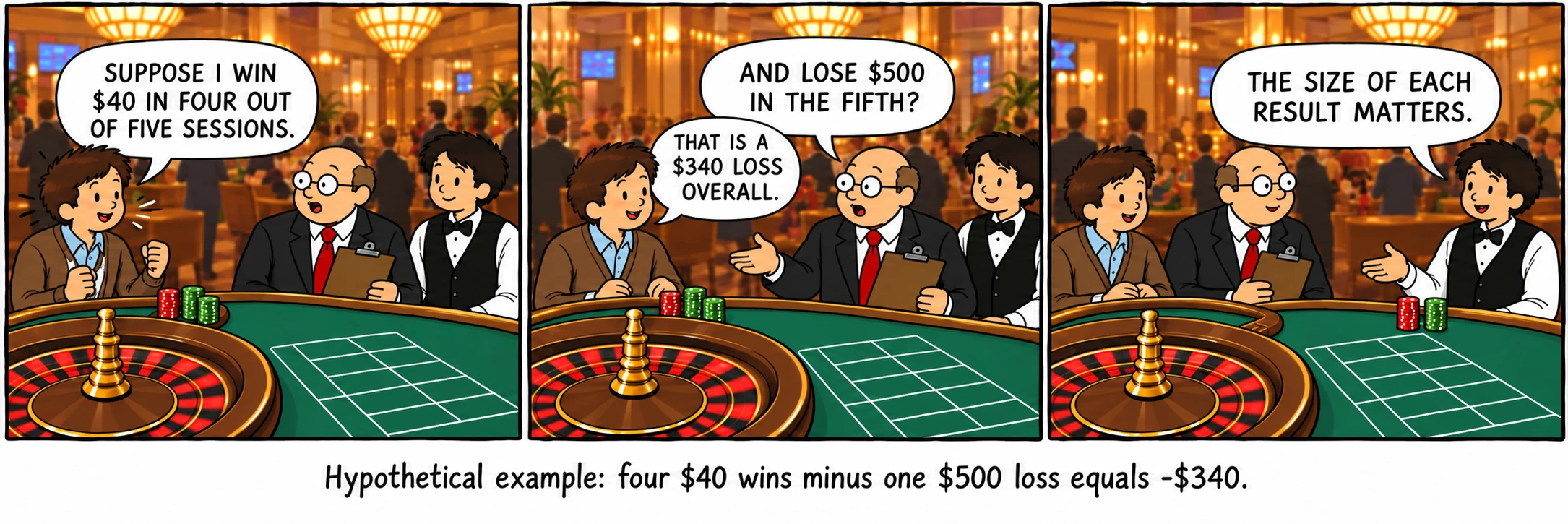
Hypothetical example: four $40 wins minus one $500 loss equals −$340.
Iwdi
- Thorp, E. O. “Optimal gambling systems for favorable games.”
- Thorp, E. O. The Mathematics of Gambling.
- Doob, J. L. “Note on probability.”
- Halmos, P. R. “Invariants of certain stochastic transformations: the mathematical theory of gambling systems.”
- Ethier, S. N. The Doctrine of Chances: Probabilistic Aspects of Gambling.
- Bollman, M. Mathematics of the Big Four Casino Table Games: Blackjack, Baccarat, Craps, & Roulette.
- Bollman, M. Basic Gambling Mathematics: The Numbers Behind the Neon, 2nd ed.