Taarorɗe Ruleet Ndeenaaka
Taarorɗe jogiiɗe cuuɗi 18, 25, 26, 31, 40, 49, 62, 73 walla 105. Sariya gooto ina tabitina coggu hakkunde majji fof: geɗal cuuɗi ɗi njoɓdi ndii yejjitata.
So njoɓdi ndii tabitinaama hono cuuɗi kasino ɗii ngalaa ɗoon, ɓural kasinomatematikƁural kasinoGeɗal kala pari ngal kasino jogiiyata e hakkundeere: 2,70% e ruleet Orop.Tar fof → ngal ko cuuɗi kasino peccaaɗi e cuuɗi ɗii fof, hay hol mawneeki taarorde ndee. Ko ɓuri heewde e taarorɗe ceertuɗe ɗee ina njokki sariya oo. Ɗe ɓuri haanude ƴeewde ko ɗe ƴeftortaa mo: njoɓdi daŋɗinaandi, taarol bonus, walla pari heddotoongal e taarle keewɗe.
Sariya gooto ngam kala taarorde
Ruleet OropfannuRuleet OropTaarorde seero gooto, cuuɗi 37, ɓural kasino 2,70%. Ko modeel ngol lowre ndee ƴettori.Tar fof → ina yoɓa 35 e 1 hono taarorde ndee ina jogii cuuɗikuutorɗeSuuduGootel e cuuɗi 37 limoraaɗi e rotoor. Ina noddee kadi: wenndu, kopp.Tar fof → 36. Nde jogii 37, suudu majjuundu ndu ko ɓural 2,70% ngal. Sariya oo ina golla e kala taarorde: e limooje N e cuuɗi kasino Z, pari e limooje n yoɓoowo (N − n)/n e 1 ina jogii ɓural Z/(N + Z). Taarorɗe kala mawneeki mahaama walla ndokkaama e dow sariya oo, tabalo oo ina lelna ɗe e coggu mum. Lelnde mum ina rokka kadi ko adii fof e no Royal Roulette, fijo Ostarali, fijetee: limooje mum ko kaartaaje 2 haa lamɗo, cuuɗi kasino mum ɗiɗi ko as e joker, kaartal gootal ina yoɓa 47 e 1.
Ɓurde mawnude ina waawi ɓurde ndiyde coggu
Players read a 62-pocket wheel as a longer shot and assume a worse game. With the proportional payoutskaalisNjoɓdiKo pari dañndi ruttata, wiyaa “X e 1” ɓeydaa e pari ruttaaɗo.Tar fof → described here, the edge is the share of house pockets. Super 62 has two zerostaarordeSeeroSuudu haako wootere nde hay pari njoɓdi fotndi, sappo e ɗiɗi walla kolon kuuɓataa; ko ɗum woni iwdi ɓural kasino. Ina noddee kadi: seero gooto, 0.Tar fof →, like the American wheel, but they are 2 of 62 pockets rather than 2 of 38, so it costs 3.23% against 5.26%. Roulette 73, with 72 numbers and one zero, would cost 1.37%, about the same as French even money. The rule works the other way on a small wheel. Bollman pictures an antique wheel of 18 pockets, 1 to 16 plus 0 and 00. On the rule every bet would cost 2/18, 11.11%: two house pockets are a large share of a small wheel.
Ɗo sariya oo ƴeftortaa: daŋɗingol
Some pay tableskaalisTabalo njoɓdiDoggol ko kala pari walla njeñtudi yoɓata. E masiŋji e pariiji sera, ko ɗoon ɓural kasino tonnditetee.Tar fof → round a fractional payout down. That raises the edge; it is not a mathematical requirement. 100 To 1 Roulette’s Avenue bet covers 15 pockets and should pay 5⅔ to 1; it pays 11 to 2, which raises its edge from 4.76% to 7.14%. On Super 62, seven numbers contain the digit 6 (6, 16, 26, 36, 46, 56, 60) and the bet on that digit pays 7 to 1, which makes it 9.68%, three times the rest of the layoutkuutorɗeTapiKaare pariiji winndaande e taabal. Ina noddee kadi: taabal, feetere, sanyo.Tar fof →. Riverboat Roulette’s White bet covers 8 numbers at 7 to 2; if a table rounds a $5 winner down to $17 instead of $17.50, the edge rises from 5.26% to 7.37%. The American five-number bet, at 7.89%, is the familiar case of the same thing.
Ɗo sariya oo ƴeftortaa: bonus
The historical Fast Action Roulette version described by Bollman (2021) uses a real wheel with four zeros, which on its own would cost 10%. Ten Bonus numbers light up at random on every spin. A straight uppariLimoore wootereLimoore wootere tan, ina yoɓa 35:1.Tar fof → pays 35 to 1, 40 to 1 if its number is a Bonus number, and 80 to 1 if its whole row of four is Bonus, which brings it to 6.65%. The three bonus bets in that version cost more. Later rules differ; our bonus-round page explains the distinction. IGT’s Double Bonus Spin adds a yellow Bonus pocket, one and a half pockets wide, to an American wheel; when the ballkuutorɗeBalBal tokoosal werlaangal e laawol ngol e laawol rotoor ngol. Balli jamaanu hannde ko ivorine walla Teflon, 18–21 mm.Tar fof → lands there, every bet gets two free spins. Applying independent outcomes to Bollman’s stated bonus-payout model gives an edge between 1.94% (a straight up) and 2.73% (even money) for the usual non-basketpariNay adanndeE taarorde seero gooto: 0, 1, 2, 3 e jetoŋ gooto, ina yoɓa 8:1. Ina wiyee kadi: basket, quatre premiers.Tar fof → bets. The five-number bet is an exception at 4.72%. Bollman (2021) prints 3% to 16% for this game; his simplified formula has an algebra slip, and for even-money betspariPari njoɓdi fotndiBoɗeere/ɓaleere, peccotaake/peccotoonde, mawɗe/tokooseeje. Limooje 18, ina yoɓa 1:1.Tar fof → it implies that the free spins lose more than the stake, which they cannot.
Ɗo sariya oo ƴeftortaa: pariiji heddotooji
Riverboat Roulette (2012) gave 32 numbers of an American wheel a second color. White marks the four pockets around each zero (1, 2, 9, 10, 13, 14, 27, 28). A bet on a color group wins if one of its numbers comes up before one of the eight White numbers. A White number is a “White Out” that clears every color bet. Every other number is a push: the bet stays up, and between spins it can be taken down or raised. Teal covers three numbers and pays 2 to 1. Per resolved bet it loses 2/11 of the stake, 18.18%. Per active spin its expected lossmatematikMajjere fodaandeNjaru fodaandu fiyaandu e kaalis pariyaaɗo fof; ko hakkundeere kaalis majjataako nder jonnde walla nder sahaa.Tar fof → is 2/38, or 5.26%. With independent uniform spins and the bet left up until it resolves, it stays active for an average of 38/11 spins, about 3.5.
Taarorde nde Thorp waawnoo anndude: Big Six
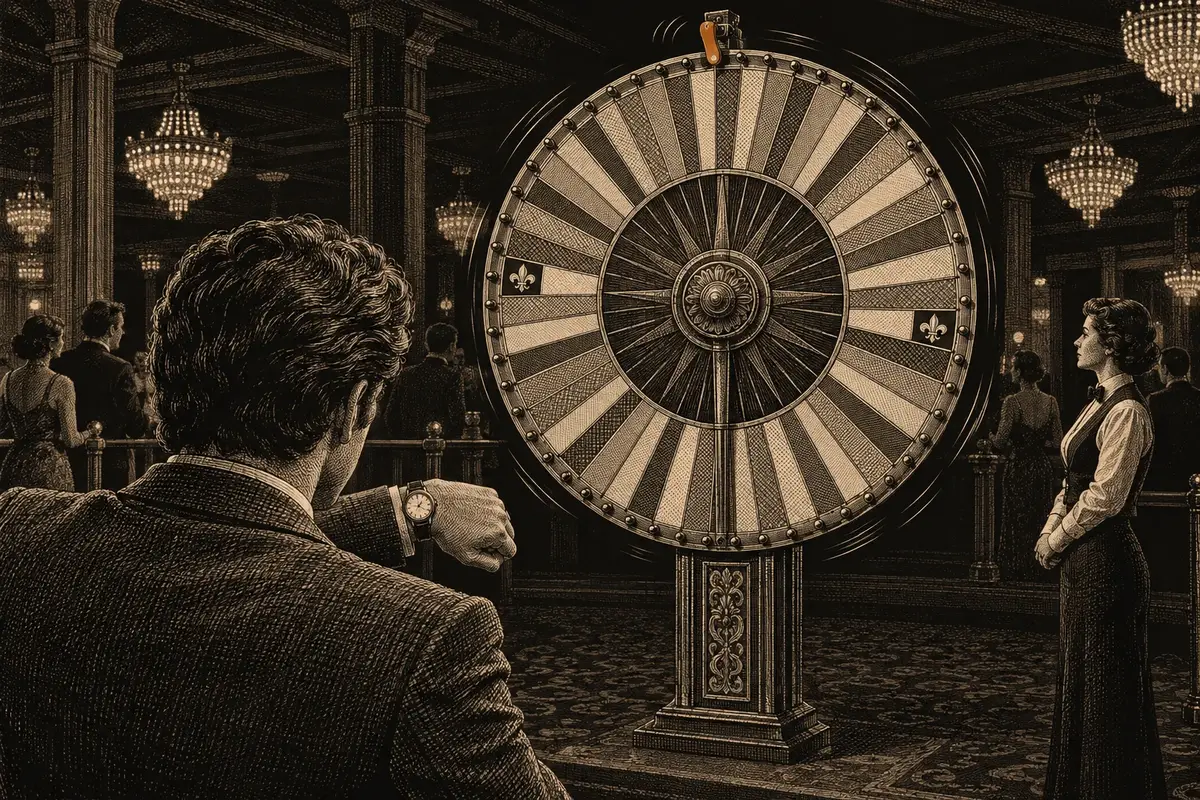
The Big Six, or wheel of fortune, is a large upright wheel with 54 slots: 24 pay 1 to 1, 15 pay 2 to 1, seven 5 to 1, four 10 to 1, two 20 to 1, and two logo slots pay 40 to 1. There is no zero; the house takes its share by paying short, and the edge runs from 11.1% on the slots that pay 1 to 1 to 24.1% on the logos. In 1961 Thorp built a matchbox-sized predictor for it, worked by a toe switch, and in October 1981 he timed a wheel at Caesars Tahoe with a wristwatch. He fitted a prediction curve to those observations, while warning that new spins would likely fit less closely. His worked example assumed errors stayed within five slots and estimated a net gain of 114 unitskaalisInitePari fuɗɗoode mo sistem walla fijoowo gollirta. Jokkondirɗe pari ina cifee e initeeji ngam ɗi kuutoroo e kala taabal.Tar fof → per 54 units wagered, about +211%, if bets were accepted after the wheel started. This was a conditional estimate, not a measured casino return. In his 1998 account, Thorp said the game had too little action to conceal the late bets his method needed. That historical account does not establish today’s betting cutoff or a current advantage.
Ko waɗi ko seeɗa e majji ɗaŋŋi
Changing the pocket count requires different equipment; adding a side betpariPari seraPari ɓeydaando suɓotoondo ƴowaando e fijo mawngo, ko ɓuri heewde e jokkondire, hewtere bonis walla jakpot. Ko ɓuri heewde ina ɓuri coggude pariiji laawol.Tar fof → can keep an existing wheel. The examples here show both approaches. Their value depends on the probabilities and payouts, not on how unusual the equipment looks.
Naamne
Wonaa e hoore mum. Ɓural ngal ko geɗal cuuɗi kasino: 1 e nder 73 ina ɓuri ndiyde coggu 1 e nder 37.
Roulette 73, e 1,37%, kono ko taarorde saakitaande tan, wonaa taabal mo heɓataa. E nder taarorɗe ɗe fijooɓe ndokkaa, Super 62 e 3,23% ina wona ɗimmo caggal Orop e Farayse.
A bonus does not automatically increase the edge. Calculate the return from the whole rule set: base payouts, bonus probabilitymatematikPorobabiliteSahaa njeñtudi, immorde 0 haa 1 walla 0% haa 100%. Limoore wootere: 1/37 = 2,70%.Tar fof →, bonus prizes and any separate stake. A bonus added without another change improves the expected return.
Weltaare e Matematik
Etu ɗum hoore maa adii. Kala jaabawol ina suuɗii; uddit ɗum so a heblii.
Consider a hypothetical uniform 50-pocketkuutorɗeSuuduGootel e cuuɗi 37 limoraaɗi e rotoor. Ina noddee kadi: wenndu, kopp.Tar fof → wheel with 48 ordinary card symbols, one ace and one joker. Bets covering 1, 2, 3, 4, 6, 8, 12, 16 or 24 ordinary symbols pay 47, 23, 15, 11, 7, 5, 3, 2 or 1 to 1 respectively. What payoutkaalisNjoɓdiKo pari dañndi ruttata, wiyaa “X e 1” ɓeydaa e pari ruttaaɗo.Tar fof → pattern and house edgematematikƁural kasinoGeɗal kala pari ngal kasino jogiiyata e hakkundeere: 2,70% e ruleet Orop.Tar fof → do they share?
Hollu jaabawol ngol
Jaabawol Pari kala e kaarteeji n ina njoɓa (48 − n)/n e 1, ndeen pari kala ina coggi 2/50 = 4%.
Ƴeewto sariya oo e pariiji seeɗa: 47/1 = 47, 36/12 = 3, 32/16 = 2, 24/24 = 1. Ina hawri e ɗi jeenay fof. Sariya oo ina taƴa coggu taarorde ndee wano ina jogii cuuɗi 48, ndeen as oo e joker oo ko cuuɗi kasino ɗiɗi ɗii, wano 0 e 00 e taarorde Amerik.
Cuuɗi kasino ɗiɗi e 50 ina rokka ɓural 4%. Mbaadi “Orop” ina momta joker oo, ina accita njoɓdi ndii: suudu kasino wootere e 49, ɓural 2,04%.
Design a digit bet on a fair American double-zerotaarordeSeeroSuudu haako wootere nde hay pari njoɓdi fotndi, sappo e ɗiɗi walla kolon kuuɓataa; ko ɗum woni iwdi ɓural kasino. Ina noddee kadi: seero gooto, 0.Tar fof → wheel. Count numbers from 1 to 36 containing each digit, and choose payouts that retain the standard 2/38 edge. Treat the zero pockets separately. Which payouts are whole unitskaalisInitePari fuɗɗoode mo sistem walla fijoowo gollirta. Jokkondirɗe pari ina cifee e initeeji ngam ɗi kuutoroo e kala taabal.Tar fof →?
Hollu jaabawol ngol
Jaabawol Groups of three or four numbers give whole-unit payouts of 11:1 or 8:1. Groups of thirteen or ten need fractional payouts to preserve the same edge.
Limo limooje ɗee. Siifar 1 ina tawee e 1, 10 haa 19, 21 e 31: limooje 13. Siifar 2 kadi ina tawee e limooje 13, siifar 3 e 10. Siifaruuji 4, 5 e 6 ina tawee e limooje nay kala (4, 14, 24, 34), 7, 8 e 9 e tati kala.
Pari e limooje n ina jogga ɓural Amerik si ina njoɓa (36 − n)/n e 1. Ɗum ina rokka 8 e 1 ngam limooje nay e 11 e 1 ngam tati, ɗiɗi ɗee fof timmuɗi. Ngam limooje 13 ina rokka 23/13, hedde 1,77 e 1, ngam limooje 10 kadi 2,6 e 1. Jippin 1,77 haa 7 e 4, pari oo ina coggoo 5,92%; ƴeesin ɗum haa 2 e 1, fijoowo oo ina jogii ɓural 2,63%. Jippingol 2,6 haa 5 e 2 ina waɗa 7,89%.
Siifar 0 ko suɓaade: 10, 20 e 30 tan ina njoɓa 11 e 1 e 5,26%; ɓeydu 0 e 00 ndeen ɗum ko pari limooje joy, 6 e 1 e 7,89%, wano nay adanndepariNay adanndeE taarorde seero gooto: 0, 1, 2, 3 e jetoŋ gooto, ina yoɓa 8:1. Ina wiyee kadi: basket, quatre premiers.Tar fof →.
siifarlimoojesariya ina wiyaina waawi njoɓeedeɓural kasino1, 2131,77 e 17 e 45,92%3102,6 e 15 e 27,89%4, 5, 648 e 18 e 15,26%7, 8, 9311 e 111 e 15,26%Suppose a uniform wheel has 100 numbered pockets and five house symbols. Bets covering 1, 2, 3, 4, 5, 10, 15, 20 or 50 numbered pockets pay 100, 49, 32, 24, 19, 9, 11/2, 4 or 1 to 1. Besides the one-pocket and fifteen-pocket bets, which payout differs from (100−n)/n, and what is its edge?
Hollu jaabawol ngol
Jaabawol Pari cuuɗi tati: sariya oo ina wiya 32⅓ e 1, ina njoɓa 32 e 1, ina coggi 5,71% nde wonaa 4,76%.
Check each payout against the rule: 98/2 = 49, 96/4 = 24, 95/5 = 19, 90/10 = 9, 80/20 = 4 and 50/50 = 1 all fit. For three pockets the rule gives 97/3 = 32⅓, a fractional payout. The stated table instead pays 32.
The bet wins 3 times in 105 spins and then returns 33 units including the stake: 3 × 33 = 99 units back for every 105 staked, a loss of 6/105 = 5.71%.
Consider a uniform 73-pocket model with 72 ordinary numbers and zero. A bet covering n numbers pays (72−n)/n to 1. Four straight-ups and ten non-overlapping splitspariLimooje ɗiɗiLimooje ɗiɗi takkondirɗe, ina yoɓa 17:1.Tar fof → cover 24 distinct gray numbers with 14 equal chipskaalisJetoŋMaande hollirde kaalis tabitiiɗo, waɗetee e tapi ngam waɗde pari. Ina wiyee kadi: check.Tar fof →. What is the spread’s edge?
Hollu jaabawol ngol
Jaabawol 1,37% jetoŋji 14 ɗii, wano pari kala e taarorde ndee.
The long way: a straight uppariLimoore wootereLimoore wootere tan, ina yoɓa 35:1.Tar fof → pays 71 to 1 and a split 35 to 1. If one of the 4 straight-up numbers comes in, you win 71 and lose the other 13 chips: +58. If one of the 20 split numbers comes in: +35 − 13 = +22. On the other 49 pockets you lose all 14. On average over 73 spins: 4 × 58 + 20 × 22 − 49 × 14 = 232 + 440 − 686 = −14 units, which is 1/73 of each chip.
The short way: expected valuesmatematikNjaru fodaanduNjeñtudi hakkundeere e kala pari e juuta. −1/37 pari ngam kala pari Orop laawol.Tar fof → add. Each chip is an ordinary bet that loses 1/73 of itself, so 14 chips lose 14/73. Here combining bets keeps the edge per chip at 1/73, while the expected lossmatematikMajjere fodaandeNjaru fodaandu fiyaandu e kaalis pariyaaɗo fof; ko hakkundeere kaalis majjataako nder jonnde walla nder sahaa.Tar fof → in chips grows with the total stake.
Super 62 ina jogii limooje 60, 0 e 00, ina njoɓa (60 − n)/n e 1. Waɗooɓe mum ɓe natii ɗum kadi e suudu kasino wootere, tati e nay. Alphabetic Roulette ina njoɓa (24 − n)/n e 1 e cuuɗi 25, ina jogii mbaadi nde Y e Z ngoni e cuuɗi mum en. Taƴ coggu ɗee joy fof.
Hollu jaabawol ngol
Jaabawol With payout base 60 and one to four house pockets: 1.64%, 3.23%, 4.76% and 6.25%. With payout base 24: 4% on 25 pockets and 7.69% on 26.
Kala e ɗeen ina jogga njoɓdi mum, ina waylita keewal cuuɗi kasino tan, ndeen ɓural ngal ko cuuɗi kasino ÷ cuuɗi fof.
Seero gooto, cuuɗi 61: 1/61 = 1,64%. Ɗiɗi, cuuɗi 62: 2/62 = 3,23%. Tati, cuuɗi 63: 3/63 = 4,76%. Nay, cuuɗi 64: 4/64 = 6,25%. Seero kala ɓeydaaɗo ina coggi hedde poen gootol e feccere.
Alphabetic ina njoɓa wano ina jogii alkule 24. Si Y e Z ina lomti suudu wootere, kasino ina jogii 1 e 25, 4%. Si Y e Z ceertii, ina jogii 2 e 26, 7,69%, hono taarorde seero tati. Feccude suudu wootere ɗiɗi ina ɓeyda coggu ngu hedde laabi ɗiɗi.
taarordecuuɗicuuɗi kasinoɓural kasinolimooje 60, seero gooto6111,64%Super 626223,23%limooje 60, seeroji tati6334,76%Super 646446,25%Alphabetic2514,00%Alphabetic, Y e Z ceerɗe2627,69%Design payouts for a hypothetical uniform 18-pocket wheel: 1–16, 0 and 00. Eight ordinary numbers are redpariBoɗeerePari njoɓdi fotndi e limooje 18 boɗeeje. E Farayse: rouge.Tar fof → and eight blackpariƁaleerePari njoɓdi fotndi e limooje 18 ɓaleeje. E Farayse: noir.Tar fof →. The ordinary numbers form a four-by-four layoutkuutorɗeTapiKaare pariiji winndaande e taabal. Ina noddee kadi: taabal, feetere, sanyo.Tar fof →. What standard payout pattern gives an 11.11% edge, and what happens if red also wins on 0?
Hollu jaabawol ngol
Jaabawol Njoɓ (16 − n)/n e 1: 15 e 1 e limoore wootere, 7 e ɗiɗi, 3 e nay, 1 e jeetati. Pari kala ina coggi 11,11%. Si 0 dañii pari boɗeere, boɗeere wonay pari potɗo.
Price the wheel as if 0 and 00 were not there. A bet on n numbers wins n times in 18 and pays (16 − n)/n to 1, so it brings back 16 units, stake included, for every 18 staked. Every bet costs 2/18, 11.11%.
The layout’s natural bets come out whole: one number 15 to 1, two side by side 7 to 1, a row or a columnpariKolonLimooje sappo e ɗiɗi e kolon ɗarngal gootal e tapi, ina yoɓa 2:1.Tar fof → of four 3 to 1, and two rows, or the odd, even, low or high eight, 1 to 1. A three-number bet would need 4⅓ to 1; rounded down to 4 to 1, it costs 16.67%.
Red covers the eight odd numbers. If 0, being red, also won the red bet, red would cover 9 of the 18 pockets at 1 to 1: a fair gamematematikFijo potngoFijo ngo hay sera wootere alaa ɓural: kala pari ina jogii njaru fodaandu potndu e seero.Tar fof → with no edge at all. In this model, excluding zero from the eight-number even-money betpariPari njoɓdi fotndiBoɗeere/ɓaleere, peccotaake/peccotoonde, mawɗe/tokooseeje. Limooje 18, ina yoɓa 1:1.Tar fof → is what preserves its 11.11% edge. Payouts on zero itself also need to follow the specified rule.
Ƴeewndo weltinoowo
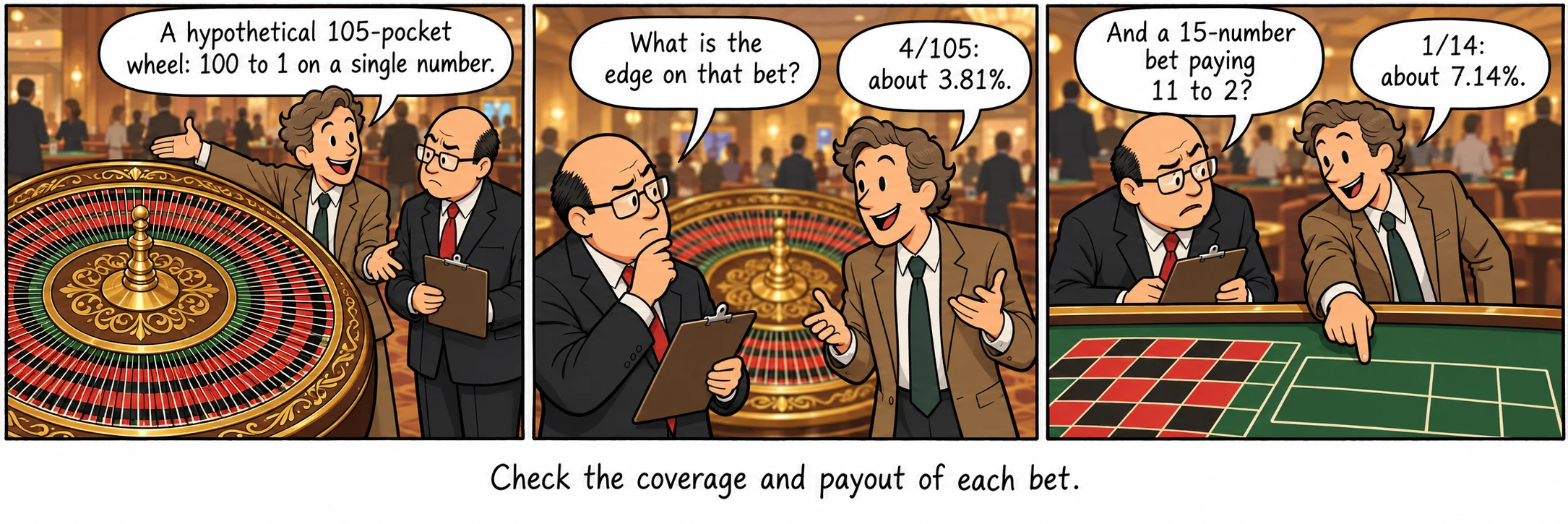
Limto cuuɗi kasino ɗii, refti ƴeewto daŋɗingol ngol.
Iwdi
- Bollman, M. Mathematics of the Big Four Casino Table Games: Blackjack, Baccarat, Craps, & Roulette.
- Ethier, S. N. The Doctrine of Chances: Probabilistic Aspects of Gambling.
- Thorp, E. O. The Mathematics of Gambling.
- Thorp, E. O. “The invention of the first wearable computer.”