Maanaa Statistik
“Tiiɗɗo” firti ina famɗi waawde waɗde e taarorde peewnde, wonaa “goonga”, wonaa kadi “ina rokka dañal”.

Njaru p 0,05 firti taarorde peewnde ina rokka mbaadi ooñiindi no ɗuum laawol gootol e noogaas. So a ƴeewii taarorɗe noogaas, gootel ina yaltoo e hawritaare.
Ko njaru p woni
Assuming the stated null model, the p-valuelaboratuwaarNjaru pPorobabilite yiyde ɓoornugol mawnungol fotde e ngol yiyaa walla ɓurngol, so tawii taarorde ndee ko peewnde.Tar fof → is the probabilitymatematikPorobabiliteSahaa njeñtudi, immorde 0 haa 1 walla 0% haa 100%. Limoore wootere: 1/37 = 2,70%.Tar fof → of a test statistic at least as extreme as the observed one. It is not the probability that the wheel is fair or that the result arose by chance. Interpretation also depends on the design, assumptions and tests attempted.
Fotndooji keewɗi
Kala ƴeewndo mo waɗataa e taarorde peewnde ina jogii sahaa 5% yaltude e keerol 5%. Ƴeewndo taarorɗe noogaas, gootel ina yaltoo. Ƴeewndo taarorde wootere e waktuuji noogaas, gooto ina yaltoo. Ƴeewndo misal gootal e pecceele cuuɗikuutorɗeSuuduGootel e cuuɗi 37 limoraaɗi e rotoor. Ina noddee kadi: wenndu, kopp.Tar fof → 37, pecceele geɗe taarordetaarordeGeɗal taarordeCeeɓnde cuuɗi takkondirɗi e taarorde, ceertunde e mooftere e tapi.Tar fof → jeegom e pecceele noone tati, huunde ina yaltoo. Safaara ndee ko tabintinde ƴeewndo oo ado ndaarde keɓe ɗee, waɗde ɗum laawol gootol, teeŋtinde e keɓe kese. Ƴeewgol ngol yiyata taarorde “ooñiinde” ko heewi ko ngol tan addi njeñtudi ndii.
Maanaa e mawneeje
A large sample can detect a small departure from fairness that still does not make a bet profitable. At a true pocket probability of 1/36.5, a 35:1 bet has negative expectation. At 1/36 it breaks even. A p-value does not measure the size or practical value of an effect.
Doole ƴeewndo
Power is the chance of rejecting the null under a specified alternative. For one pocket chosen in advance, an exact one-sided 5% binomial test on 1,000 spins rejects at 37 or more hits. If the true rate is 1/30, its power is about 28%, not 50%.
Keerol nafoowol
Ngam wiyde ooñol ina woodi wona huunde ndaaretee: ƴeewndo suɓaaɗo ado, p < 0,01 wonaa 0,05, waɗtugol e misal ceertungal mawneeje mum nanndi, e keewal hebgol hiisaaɗo e cuuɗi suɓaaɗi 1/34 walla ko ɓuri caggal waɗtugol. Ngol keerol heɓaama laabi seeɗa e taariik fijo ngo, alaa hay laawol, no doggole renndo kollirta, e taarorde jamaanu aynaande.
Naamne
Aada gila duuɓi 1920. Alaa ko ɗum ceerti; 0,01 ko keerol ɓurngol haanude so aɗa ƴeewa taarorɗe keewɗe.
Ina sikkitii wonde ina rokka njeñtuɗi fotɗi. Ina waawi wonde ko kurupiye, juumre winndugol walla caɗeele naatnugol keɓe. Waɗtu.
No. That requires a separate estimate of hit probability, its uncertainty and the actual payoutkaalisNjoɓdiKo pari dañndi ruttata, wiyaa “X e 1” ɓeydaa e pari ruttaaɗo.Tar fof →.
Weltaare e Matematik
Etu ɗum hoore maa adii. Kala jaabawol ina suuɗii; uddit ɗum so a heblii.
Suppose a dozenpariSappo e ɗiɗi1–12, 13–24 walla 25–36, ina yoɓa 2:1.Tar fof → chosen before data collection appears 742 times in 3,000 independent double-zerotaarordeSeeroSuudu haako wootere nde hay pari njoɓdi fotndi, sappo e ɗiɗi walla kolon kuuɓataa; ko ɗum woni iwdi ɓural kasino. Ina noddee kadi: seero gooto, 0.Tar fof → spins. Under the uniform model, how many standard deviationsmatematikSeerndu ndenndaanduRaasin karee wariyaas; ko woɗɗeende aadanteende njeñtudi e njaru fodaandu.Tar fof → below the mean is that? What is the probabilitymatematikPorobabiliteSahaa njeñtudi, immorde 0 haa 1 walla 0% haa 100%. Limoore wootere: 1/37 = 2,70%.Tar fof → of 742 or fewer hits?
Hollu jaabawol ngol
Jaabawol Hono seerɗe ndenndaaɗe 8,1 les. Taarorde peewnde ina waɗa ɗum hono laabi gooto e nder etaaɗe 3 × 10¹⁵, ɗum ko abada. Jaabawol yaltinaangol e naamnal ngal ina wiya 11,75; men keɓi 8,07.
Under the stated model, X is binomial with n = 3,000 and p = 12/38. Its mean is np ≈ 947.37 and its standard deviation is √(np(1 − p)) ≈ 25.46.
The standardized difference is (742 − 947.37)/25.46 ≈ −8.07. Summing the exact binomial probabilities from 0 through 742 gives P(X ≤ 742) ≈ 9.77 × 10⁻¹⁷. A normal approximation with continuity correction gives about 4.25 × 10⁻¹⁶; the relative error is large this far into the tail.
This is the probability of the specified data event under the model, not the probability that the wheel is fair. Such a result calls for checking the observations, independence, uniformity and analysis plan. Selecting the worst-looking dozen after inspecting data, or searching many wheels or time periods, requires accounting for that selection.
Ƴeewndo weltinoowo
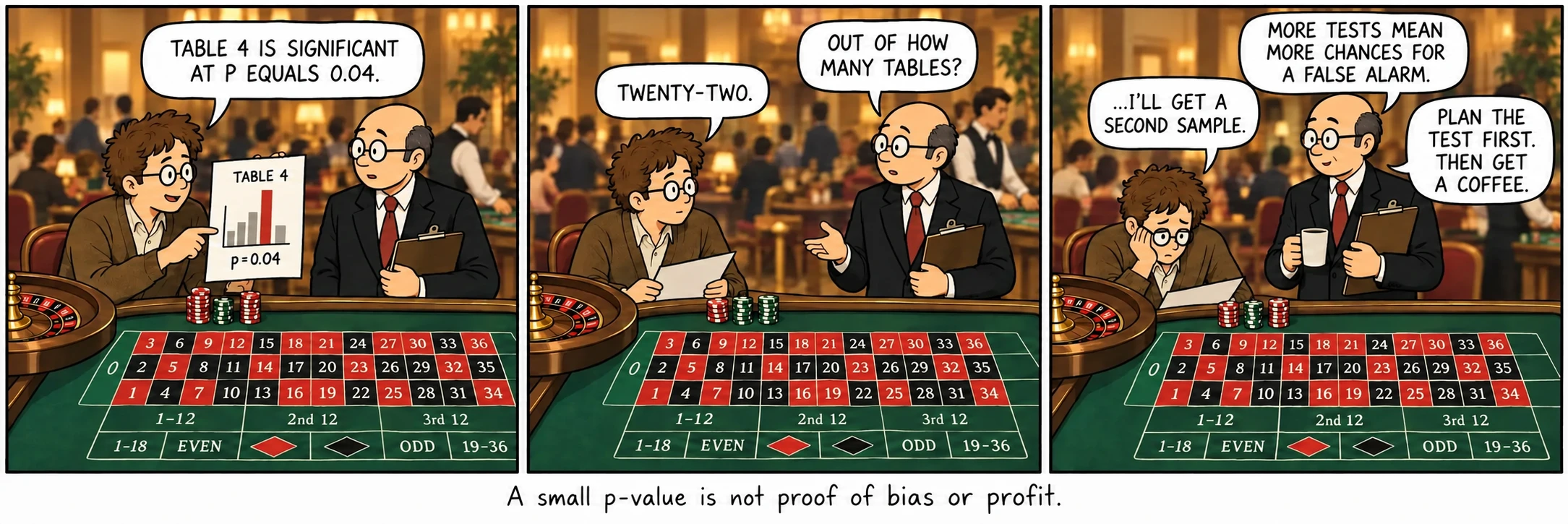
Taarorde peewnde wootere e noogaas ko “tiiɗnde”. Ko ɗum limoore ndee firti.
Iwdi
- Pearson, K. “On the criterion that a given system of deviations from the probable…”
- Feller, W. An Introduction to Probability Theory and Its Applications, Vol. 1.