Dabare Ruleet Paroli (Martingale Huccitinaangal)
Dabare ruleet ParolidabareParoliJokkondiral pari caggal dañal: ɓeydu pari ɗiɗi laabi caggal dañal, ruttu e fuɗɗoode caggal majjere walla caggal dañe tati jokkondirɗe. Ina noddee kadi: Martingale huccitinaangal.Tar fof → ina lomtina pari laabi ɗiɗi caggal dañal, ina fuɗɗita caggal majjere walla caggal dañe tati jokkondirɗe.
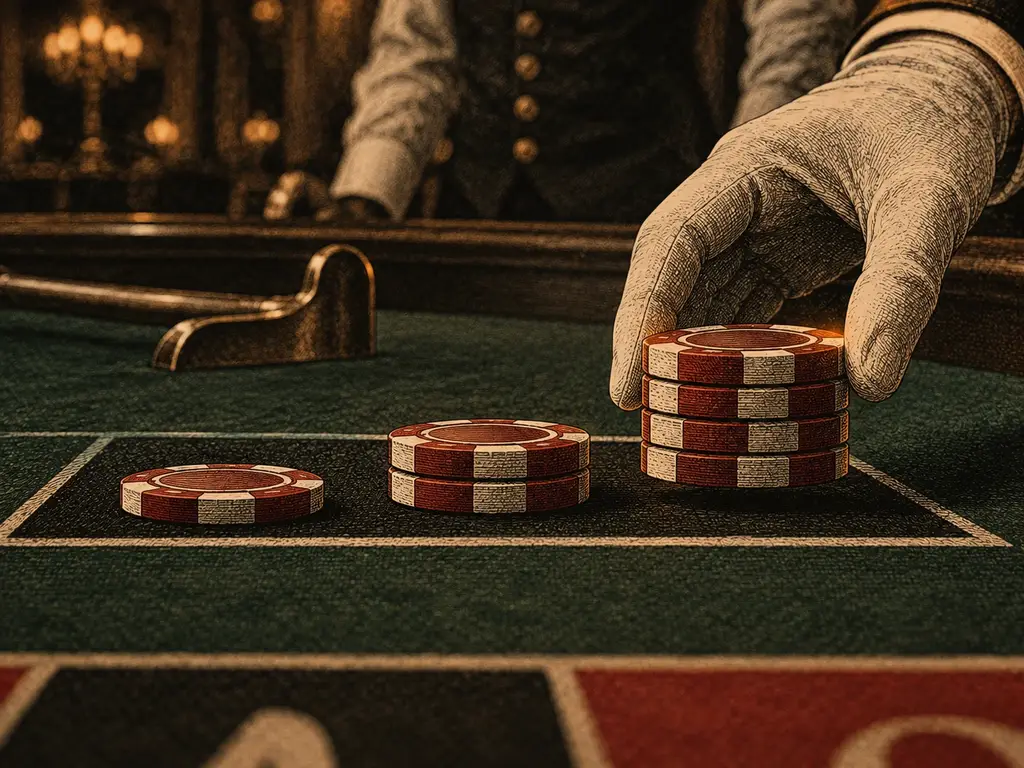
It does not beat the wheel; it only changes how the losses arrive. A completed uncapped three-win cycle nets either +7 base units or −1. Winnings remain your money when you stake them again; expected loss depends on total turnover.
Yah e sistem ngoo
Dañal ina yaha daawal gootal yeeso. Majjere, walla dañal tataɓal, ina rutta e fuɗɗoode.
Pariiji e njeñtuɗi ina limtee e initeeji pari fuɗɗoode.
Hol no sistem ruleet Paroli gollirta?
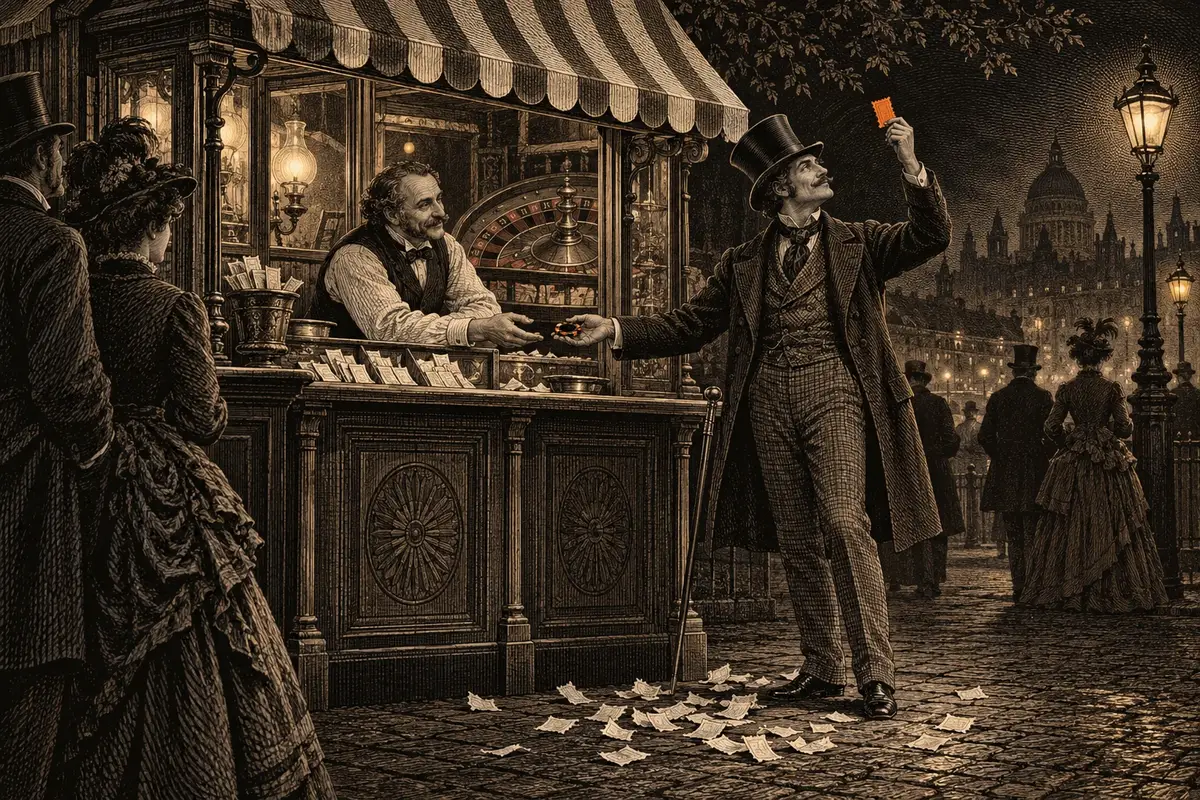
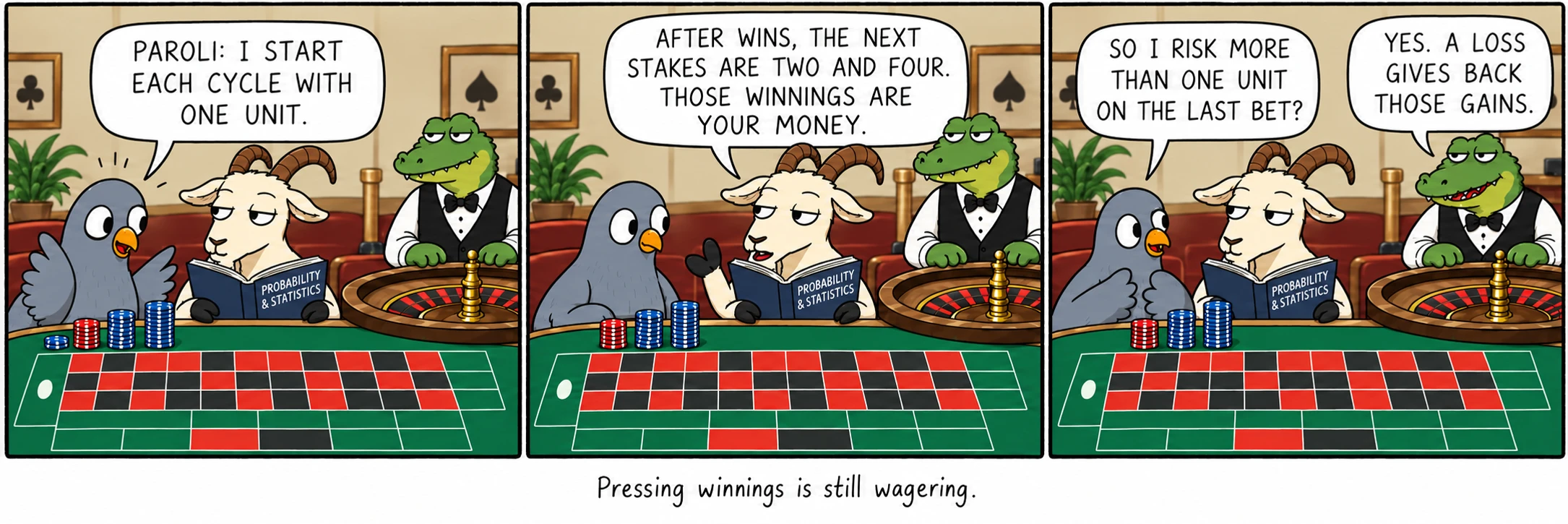
Bet one unitkaalisInitePari fuɗɗoode mo sistem walla fijoowo gollirta. Jokkondirɗe pari ina cifee e initeeji ngam ɗi kuutoroo e kala taabal.Tar fof →. Win, and leave it all on the table: the next bet is two. Win again, and it is four. Win a third time, collect seven units of profit and go back to one. Lose at any point and you go back to one as well. That is the whole system. If the progressiondabareJokkondiral pariKala sariya waylowo pari e njeñtuɗi ɓennuɗi. Jokkondiral caggal majjere ina ɓeyda pari caggal majjere, caggal dañal ina ɓeyda ɗum caggal dañal.Tar fof → runs without clipping, a losing cycle ends one unit below its starting balance. A loss at the four-unit stage still gives back four units from the balance immediately before that spin. Three even-money wins in a row happen with probabilitymatematikPorobabiliteSahaa njeñtudi, immorde 0 haa 1 walla 0% haa 100%. Limoore wootere: 1/37 = 2,70%.Tar fof → (18/37)³ = 11.5%, about one cycle in nine.
Hol no jonnde nanndirta?
Completed cycles net −1 unit unless three consecutive wins produce +7. Over exactly 100 spins, an exact finite-state calculation gives about 38.43% net-profit probability and expected result −4.56 base units. This calculation starts at one unit, resets after a loss or three wins, and assumes enough funds with no stake clipping. BankrollkaalisKaalis pariKaalis fof ko seŋaa ngam fijde. Toppitagol kaalis pari ko ñaawde ko foti waɗeede e kala pari e kala jonnde.Tar fof → limits and interrupted cycles change the distribution.
- p10 −$500
- p25 −$500
- medyan −$300
- p75 +$30
- p90 +$320
Hol sistem Paroli ina golla?
It does not create a positive expected return. It changes both the distribution and turnoverkaalisKaalis pariyaaɗo fofKawrital kaalis pariyaaɗo nder jonnde walla sahaa, limtaa kadi kaalis dañaaɗo pariyaaɗo kadi. Ina noddee kadi: handle, action.Tar fof →, so expected session loss can change. Let p = 18/37. Win 7 with probability p³ = 0.115; lose 1 with probability 1 − p³ = 0.885. Expected result per cycle: 8p³ − 1 = −0.078909 units. Expected units wagered per cycle: 1 + 2p + 4p² = 1 + 0.973 + 0.947 = 2.92. Using unrounded values, −0.078909 / 2.919649 = −1/37. This is the standard single-zerotaarordeSeeroSuudu haako wootere nde hay pari njoɓdi fotndi, sappo e ɗiɗi walla kolon kuuɓataa; ko ɗum woni iwdi ɓural kasino. Ina noddee kadi: seero gooto, 0.Tar fof → expected lossmatematikMajjere fodaandeNjaru fodaandu fiyaandu e kaalis pariyaaɗo fof; ko hakkundeere kaalis majjataako nder jonnde walla nder sahaa.Tar fof → per unit wagered.
The tempting thought is that the pressed chipskaalisJetoŋMaande hollirde kaalis tabitiiɗo, waɗetee e tapi ngam waɗde pari. Ina wiyee kadi: check.Tar fof → are the casino’s money, so staking them costs nothing. They are yours from the moment they are paid, and each one put back on the table carries the same 2.70%.
Hol si a sabbii dañe nay jokkondirɗe?
Consider an explicit four-win model: independent standard single-zero bets on redpariBoɗeerePari njoɓdi fotndi e limooje 18 boɗeeje. E Farayse: rouge.Tar fof →, one-unit base, no table limittaabalKeerol taabalPari ɓurɗo famɗude e ɓurɗo mawnude jaɓaaɗo. Keerol dow ngol ko ngol dartinta jokkondirɗe pari ɓeydooje ɗiɗi laabi.Tar fof →, and stopping at the first completed four-win cycle or when the bankroll is exhausted. Four wins turn one unit into 16, a net gain of 15, with probability p = (18/37)⁴ ≈ 5.6012%. Each failed cycle loses one unit. With 15 starting units, the chance of completing a four-win cycle before ruin is 1 − (1 − p)¹⁵ ≈ 57.9%. That is higher than the 48.6% win probability of a single 15-unit red bet, but the rewards differ. Conditional on completing the cycle before ruin, the average net session gain is about 9.1 units after earlier failed cycles. Including failures, expected net result is about −1.07 units, versus −15/37 ≈ −0.41 for the single bet. A greater success probability does not imply a better expected return.
Hol ɗo darotoɗaa ina hiisaa?
Ko e mbaadi tan. Paroli haa dañe ɗiɗi (ƴettude 3) walla dañe nay (ƴettude 15) ina waylita keewal dañe e njeenaari, wonaa ɓural ngal. “Parlay” e pari limoore wootere (accude dañal 35 e 1 ina jokka) ko miijo gootum e p = 1/37 e njoɓdikaalisNjoɓdiKo pari dañndi ruttata, wiyaa “X e 1” ɓeydaa e pari ruttaaɗo.Tar fof → 1 295 e 1 e dañe ɗiɗi jokkondirɗe, ɗum waɗi ko ɗum ko ko taalol ɓuri, wonaa ko waɗetee.
Hol suɓotoo ɗum, ngam hol ko?
The rule limits a completed losing cycle to one base unit below its starting balance, provided stakes are not clipped. Repeated failed cycles can still exhaust a bankroll, and a loss after wins gives back accumulated gains. Under the stated fair-wheel model, expected loss is 1/37 of expected turnover; a session need not lose exactly that fraction.
Simulateer · Paroli
Jonɗe 2 000 pariiji njoɓdi fotndi, fuɗɗoraade kaalis pari $1 000.
Pari fuɗɗoode $10 · keerol taabal $500 · taarle 100 e kala jonnde
Naamne
Ina ɓuri hisde sabu waawaa addude majjere wootere masiibo. Ɓuraani hoyde: majjere fodaande e inite kala pariyaande ko nde wootere.
Nokku darnude kala ina woni gootum e hiisa. Tati ina kuutoree sabu njeenaari ndii (initeeji 7) ina yonii sabbude, keewal dañe (11,5%) kadi wonaa ko alaa jikkaare.
Ƴeewndo weltinoowo
Ruttude kaalis dañaaɗo e taabal ko pariyde tan kadi.
Iwdi
- RouletteDoc. Ƴeewndo kuuɓal dabareeji ruleet.
- Roulette77. Siforgol dabare e misalji.
- Ethier, S. N. The Doctrine of Chances: Probabilistic Aspects of Gambling.
- Epstein, R. A. The Theory of Gambling and Statistical Logic, 2nd ed.
- Taylor, D. G. Games, Gambling, and Probability: An Introduction to Mathematics, 2nd ed.